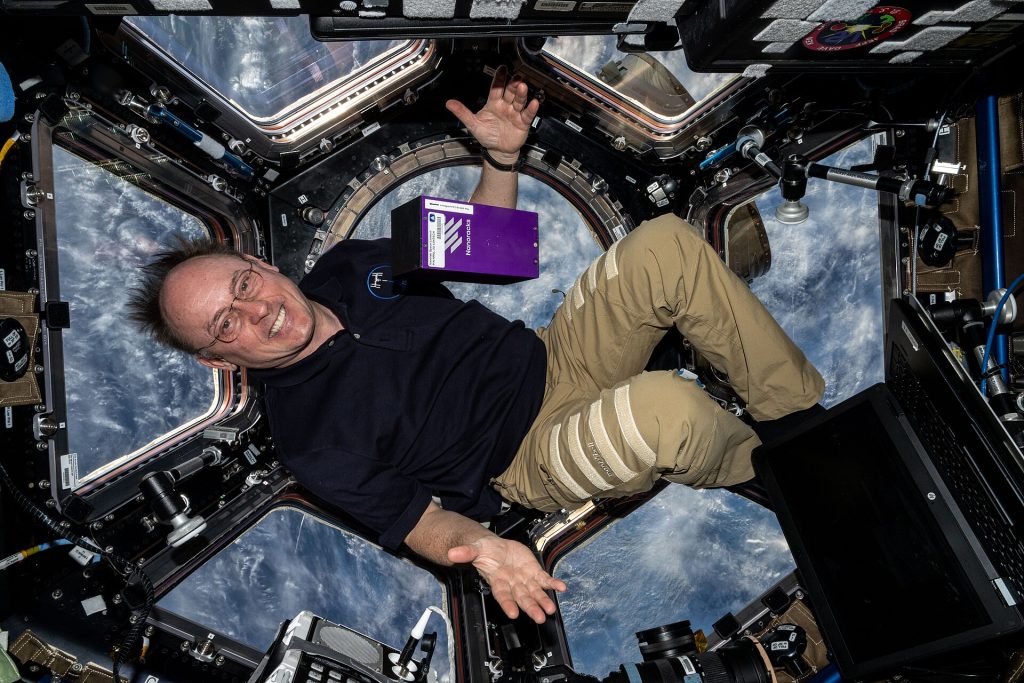
Featured image: NASA astronaut Mike Fincke displays protein crystal research hardware aboard the International Space Station. Photo: NASA (public domain).
It sounds like a punchline — factories in orbit making medicine — until you look at the physics. Some of the most valuable drugs in the world are crystals, and gravity is quietly sabotaging them. That is why a growing corner of the pharmaceutical industry now runs its experiments 250 miles up, and why one of the leading companies doing it sits in El Segundo.
Why gravity is the problem
Most medicines are formulated as crystals — the crystalline state is the most stable form of a drug, and how a crystal is built determines how the medicine dissolves, how long it survives on a shelf, and how it can be delivered. On Earth, two gravity-driven effects corrupt crystal growth. Sedimentation makes heavier particles sink; convection makes warm fluid rise and cold fluid fall, churning the growing crystal’s environment. The result is crystals of mixed sizes, with defects, in the same batch.
In orbit, a laboratory is in continuous free fall, so those effects largely vanish. Molecules assemble slowly and evenly. The crystals that come back tend to be larger, better ordered and — critically — uniform. Uniformity is not an aesthetic preference. A suspension of same-sized crystals is thinner and flows predictably, which can turn a drug that today requires an hours-long intravenous drip in a hospital into a quick injection under the skin. The same molecule can crystallize in different arrangements, called polymorphs, with different solubility and stability — microgravity can produce forms that Earth-bound labs struggle to make at all.
The proof: Merck’s Keytruda experiments
The industry’s founding case belongs to Merck. Beginning in 2014, Merck flew crystallization experiments on its cancer immunotherapy pembrolizumab — Keytruda, one of the best-selling drugs on Earth — to the International Space Station. Its 2019 paper reported that the space-grown crystals formed a strikingly uniform population around 39 micrometers across, where matched Earth experiments produced two clumps of sizes, around 13 and 102 micrometers. The orbital suspensions were less viscous and settled evenly.
Merck then did the economically decisive thing: it reverse-engineered the orbital conditions back home, using rotational mixing and temperature control to reproduce the uniform suspensions on Earth. That line of work contributed to the subcutaneous formulation of Keytruda — an injection taking minutes instead of an IV drip — which the FDA approved in September 2025 as Keytruda Qlex. The drug patients receive is made on Earth. What space supplied was the knowledge of what the crystals should look like — knowledge gravity had hidden.
The factory model: Varda Space Industries
Varda, headquartered in El Segundo, skips the space station entirely. Its W-Series is a free-flying capsule — about 300 kilograms — that carries an automated pharmaceutical reactor into orbit, crystallizes a drug there, then dives back through the atmosphere under a heat shield and parachutes to Earth.
Its first capsule, W-1, launched in June 2023 and, after months waiting on reentry approvals, landed at the Utah Test and Training Range on February 21, 2024 — the first commercial spacecraft to land on a U.S. military range, under the FAA’s first Part 450 reentry license. Inside were crystals of Form III of ritonavir, an antiretroviral — a crystal form prized precisely because it is hard to produce reliably on Earth. An April 2026 peer-reviewed study confirmed the orbit-grown form survived launch, orbit and reentry intact. Varda has since landed W-2 and W-3 at the Koonibba Test Range in South Australia (with a 20-reentry agreement running through 2028) and flown on through W-6, which reentered in May 2026. It raised $187 million in a July 2025 Series C — about $319 million in total — and in May 2026 announced a partnership to process medicines in orbit for United Therapeutics. Between pharma flights, the same capsules earn money as hypersonic testbeds for the Air Force, a second revenue stream that keeps the factory flying.
The platform model: Redwire, Lilly, Bristol Myers Squibb
Redwire takes the opposite approach: rent space on the station. Its PIL-BOX is a small automated laboratory that crystallizes proteins and drug compounds aboard the ISS. Redwire’s dedicated pharmaceutical subsidiary, SpaceMD, says it has flown 54 PIL-BOX units and tested 37 compounds, working with Eli Lilly, Bristol Myers Squibb and Aspera Biomedicines, among others. Its business model is the “seed crystal”: grow a small quantity of perfect crystals in orbit, then use them as seeds to grow large batches on Earth. Other players are further out on the curve — LambdaVision is developing an artificial retina whose protein layers are assembled in microgravity, and Britain’s BioOrbit aims to crystallize biologic drugs in orbit well enough to make at-home cancer treatment practical.
The honest limits
Perspective matters. No medicine sold today contains an active ingredient manufactured in space; the ritonavir result is a proof of feasibility, not a product. Orbital manufacturing only pencils out for products that are extremely valuable and extremely light — a vial’s worth of crystals can seed or supply enormous value, which is precisely pharma’s profile and almost nobody else’s. The regulatory path for orbit-made drug material is still being written, and the ISS — still the main laboratory — is scheduled for retirement around 2030, which is why free-flying capsules and planned commercial stations matter to this industry.
But the direction is set. A decade ago this was a NASA curiosity. Today it has an FDA-approved formulation descended from orbital experiments, a Southern California company flying drug factories on a near-monthly cadence, and the largest drugmakers in the world buying time on orbital lab benches. The next blockbuster may still be invented on Earth — but increasingly, it may need a trip to space to become a medicine people can actually use.
Sources: Merck/MSD pembrolizumab crystallization research (ISS experiments; 2019 npj Microgravity paper) and FDA approval of Keytruda Qlex (Sept. 19, 2025); Varda Space Industries mission records (W-1 through W-6) and its April 2026 peer-reviewed ritonavir stability study; Redwire/SpaceMD PIL-BOX program descriptions and CNBC reporting; ISS National Laboratory materials.
