Caltech’s president has a prediction about where the next great leap in computing will happen — and it is not Silicon Valley or a laboratory across the ocean. “I’m convinced that the future of quantum is being shaped right here in Pasadena,” Ray Jayawardhana told the third annual Caltech–Broadcom Technology symposium this week.
The gathering, held in the new Allen and Charlotte Ginsburg Center for Quantum Precision Measurement on the Caltech campus, brought together the institute’s quantum researchers and executives from Broadcom, the semiconductor and infrastructure software company best known for the advanced silicon and connectivity in AI data centers, smartphones, and the internet. The symposium is part of a five-year collaboration between Caltech and Broadcom, begun in 2023, to advance quantum science research and discoveries that could lead to new technologies and applications. The collaboration has funded 26 Caltech researchers to date and includes the new Broadcom Quantum Laboratory, housed inside the Ginsburg Center.
It was the first conference ever held in the Ginsburg Center’s first-floor symposium room. The building itself is part of the story: its ceiling is lined with curved wooden slats that interact like waves, a nod to the wave-like nature of quantum particles such as photons and electrons. The center was funded by several donors, including Broadcom, and is part of a broader network of quantum researchers and engineers extending from the Caltech campus to NASA’s Jet Propulsion Laboratory, which Caltech manages for NASA.
Quantum’s roots run through Pasadena
Jayawardhana opened the symposium by tracing the field back to Caltech itself. “Quantum science has deep roots here at Caltech, starting with Richard Feynman’s early vision of quantum computing and continuing through pioneering experiments in quantum entanglement and teleportation,” he said. “Our faculty have defined, and continue to define, the frontier of this remarkably exciting field. With a thriving research ecosystem across campus and its vicinity, we are poised to lead the next great advances in quantum science and technology.”
Charlie Kawwas, president of Broadcom’s semiconductor solutions group, spoke at the building’s dedication ceremony in June and returned for the symposium. His case for quantum is blunt: “As you probably all know, AI is dominating every discussion today, especially with my children and also my employees,” he said in June. “However, when we look beyond AI, and we take a look at the long-term horizon, especially for technologies that we can turn into products, we truly believe that the potential of quantum computing is even greater, deeper, and more disruptive than AI.”
AI and quantum, each building the other
The symposium’s first panel took up the question the whole field is arguing over: will quantum computers help advance AI, or will AI help build tomorrow’s quantum computers? Hirosi Ooguri, the Kent and Joyce Kresa Leadership Chair of the Division of Physics, Mathematics and Astronomy and the Fred Kavli Professor of Theoretical Physics and Mathematics, moderated. He opened by presenting Kawwas with a custom-made sculpture — an engraved 3D glass picture of the Ginsburg building set on a base that includes a portion of a 1920s wall from the time of Caltech’s founding, along with wood from a 400-year-old Engelmann oak that predated the campus. Kawwas replied that the piece was “very special because my father was a carpenter.”
The panelists were John Preskill, the Richard P. Feynman Professor of Theoretical Physics and the Allen V. C. Davis and Lenabelle Davis Leadership Chair of the Institute for Quantum Information and Matter; Manuel Endres, professor of physics; and Andrei Faraon, the William L. Valentine Professor of Applied Physics and Electrical Engineering and the Fletcher Jones Foundation Director of the Kavli Nanoscience Institute. All three are members of Oratomic, a Caltech quantum computing spinoff that has raised $775 million in venture capital to build a working neutral-atom quantum computer within the decade.
Kawwas argued that the age of “agentic AI” — AI agents carrying out multiple tasks on their own — will demand data centers built from heterogeneous processors: CPUs, custom accelerator units, graphics processors, and eventually quantum processing units. The hardest part of scaling those systems, he said, is connectivity. “Connectivity will be critical, not just for agentic AI to scale but on the quantum side too, especially photonic connectivity. I think we should collaborate more there, and I believe it will be critical for the next five years.”
Preskill’s message was that the machines themselves are closer than they look. “We expect dramatic progress in quantum error correction over the next couple of years,” he said. “Once we have those capable machines, the application space will expand dramatically.” Error correction matters because quantum bits, or qubits, are fragile, and errors arise as a natural consequence of that fragility.
The panel also wrestled with the practical work of getting there. Endres said his team is already using AI for experimental design and control, and that “AI will play a huge role in realizing fault-tolerant, utility-scale quantum computers, which is what we want.” Faraon stressed that scaling up will depend on infrastructure AI has already proven — optical fibers and silicon photonics — because interconnecting quantum computers “is a daunting optical engineering challenge.”
Quantum intelligence — and the workforce to build it
Robert Huang, an assistant professor of theoretical physics and a member of Oratomic, gave a talk later in the day on “quantum intelligence,” the idea of intelligence emerging from quantum computers rather than classical ones. In a recent study, he and his colleagues showed that a small quantum computer could in theory learn from massive amounts of classical data, such as gene-sequencing data, using much less memory than a classical machine would require. “Nature is not classical, so if you want to create intelligence that truly understands nature, we had better make it quantum mechanical,” Huang said.
The day closed on a question Ooguri put to the panel: how should Caltech and Broadcom prepare students and the workforce for an increasingly interdisciplinary future? Kawwas said multidisciplinary knowledge is the key — Broadcom needs engineers who are not only the best chemist or electrical engineer, but who can work across fields. Preskill agreed, pointing out that the Ginsburg Center itself was designed to bring together separate groups working on different aspects of quantum science. “We’re confident it will ignite the discussions and collaborations that broaden the educational experience.”
The symposium also featured other talks by Caltech and Broadcom speakers, breakout sessions, and tours of the laboratory of Maria Spiropulu, the Shang-Yi Ch’en Professor of Physics, and of JPL facilities. For Pasadena, the takeaway is concrete: the building, the laboratory, the researchers, and the partnership are all here — and the work they are doing is aimed at the machines that come after AI.
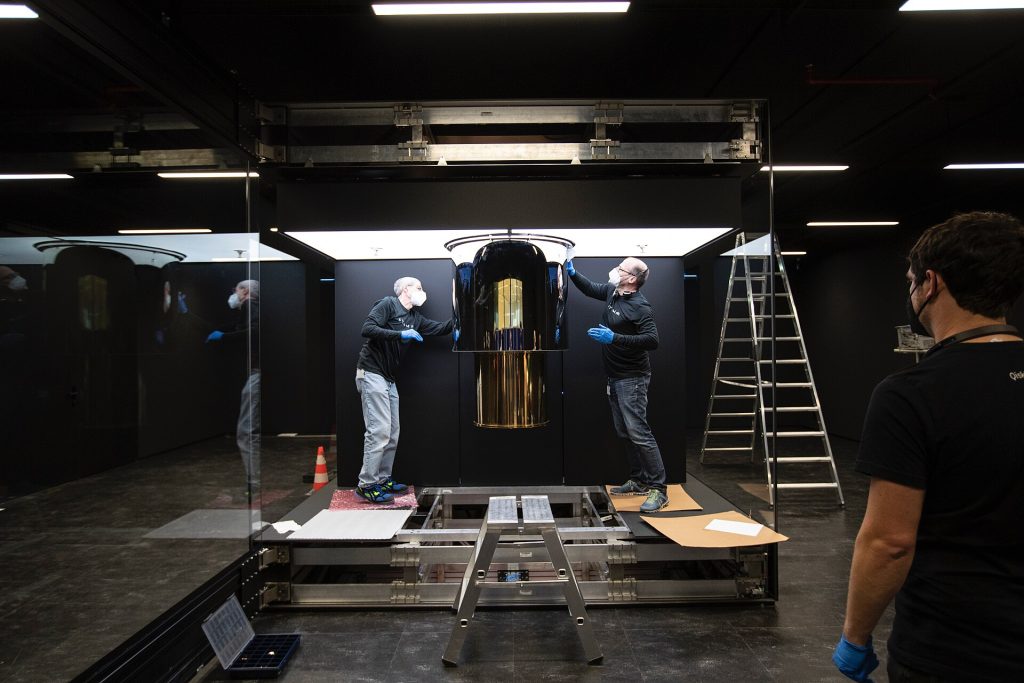
Sources: Caltech News, “Caltech and Broadcom Gather to Map the Quantum Future” (November 13, 2026). Featured photo: an IBM quantum computing system, photo by IBM Research via Wikimedia Commons (CC BY 2.0).
