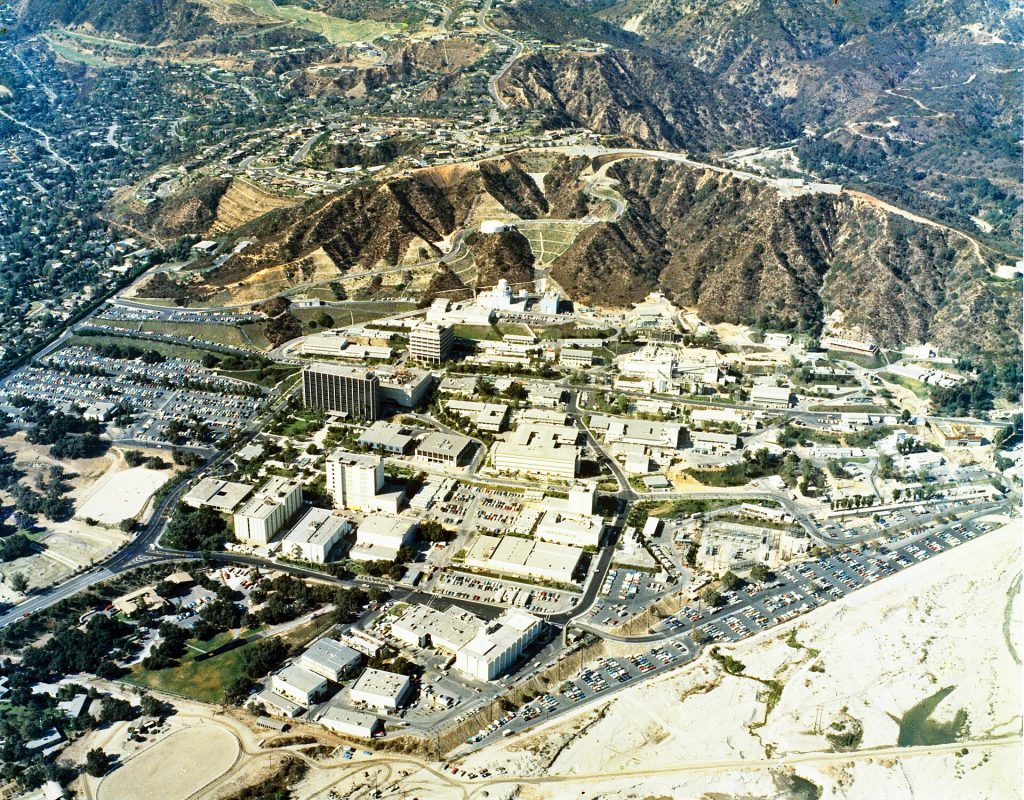
For ninety years, one question has followed NASA’s Jet Propulsion Laboratory around Pasadena: is it Caltech’s JPL, or NASA’s JPL? This month, that question got a public airing — and the answer is now genuinely up for grabs.
On May 22, NASA announced it will open the next contract to manage and operate JPL to competition, for the first time in the laboratory’s history. Caltech has managed JPL for NASA since 1958, when the laboratory was transferred from the U.S. Army to the newly created space agency, and every management contract since has been awarded to Caltech without competition. The current contract began October 1, 2018, runs through September 30, 2028, and carries a potential maximum value of $30 billion if all options are exercised.
NASA said the competition is intended to ensure accountability, taxpayer value, and continued mission performance at the laboratory, which is NASA’s only federally funded research and development center. The agency pointed to the rapid growth of the U.S. space economy, arguing that a viable competitive market for operating an institution like JPL may now exist.
Caltech says it welcomes the fight
Caltech did not greet the announcement as a surprise. In a letter to the Caltech and JPL community the same day, Caltech President Thomas F. Rosenbaum and JPL Director Dave Gallagher said the announcement “comes as no surprise” and that Caltech “welcome[s] a fair and open competition.” The letter noted that Caltech had established a team last summer to prepare for the process and will respond once NASA releases a request for proposals. Rosenbaum and Gallagher framed the competition as part of a standard federal procurement process, pointing to NASA’s earlier market research through a Sources Sought Notice and an Industry Engagement Day held in July 2025.
NASA Administrator Jared Isaacman, in a letter to the agency’s workforce, wrote that the procurement “will take several years, and I do not anticipate it having any impact on the projects underway or the location of the facilities.” NASA has said it intends to maintain JPL’s existing physical location and continuity for active and future missions throughout the process.
The competition is already moving
What was an announcement in May is now an active procurement. NASA posted a request for information and sources-sought notice on August 3, inviting interested entities to review and comment on a draft statement of work for managing and operating JPL. An Industry Engagement Event at JPL followed on October 21–22, giving prospective bidders a tour of the laboratory and access to NASA’s JPL management office and source evaluation board. NASA updated the notice on October 28 with a summary of the questions and answers from that event, a list of attendees, and copies of the presentations. The final solicitation — the request for proposals that bidders will actually answer — has not yet been released.
At least one challenger is already organizing. The Texas A&M University System’s Board of Regents authorized the system at its September 2–4 meeting to build and lead a team to prepare a proposal for the management and operation of JPL. A system spokesperson confirmed the authorization to The Battalion, Texas A&M’s student newspaper, in September, while declining to discuss potential partners, team structure, or procurement strategy “because this is an active federal competition.” Chancellor Glenn Hegar called the system a strong contender, pointing to its co-management of other federal facilities, including Los Alamos National Laboratory and the Pantex nuclear weapons plant, and to a research partnership with JPL that dates back to 2019.
Ninety years, and a historian’s question
The competition’s arrival in the lab’s 90th year has not gone unnoticed. On November 6, the Planetary Society’s Space Policy Edition released an episode titled “Whose JPL is it?”, in which host Casey Dreier spoke with historian Peter Westwick, author of “Into the Black: JPL and the American Space Program, 1976–2004.” The episode traces JPL’s path from the Caltech graduate students who hauled a rocket motor into the Arroyo Seco on Halloween in 1936 — the experiment regarded as the lab’s unofficial birthday — through Army rocketry to the outer planets, and the moments when the lab had to reinvent itself to survive.
That history is the heart of the stakes for Pasadena. JPL is the city’s largest scientific institution and one of its largest employers, and it is the lab that built and operates the Voyager spacecraft, the Mars rovers, and the missions now heading for the Moon. The lab is also coming off four rounds of layoffs since January 2024 that together eliminated more than 1,500 positions, and a workforce that includes many people affected by the January Eaton Fire in Altadena. The Caltech–JPL community letter noted that as many as five launches are planned for 2028 — FALCON, EAGLE, SkyFall, MoonFall, and GRACE-C — all of which will proceed under whichever organization holds the contract.
What happens next is procedural, and slow. NASA has not said when the request for proposals will be released, who besides Caltech and Texas A&M will bid, or what criteria will decide the award. What is settled is that the era in which Caltech’s stewardship of JPL was automatic is over. For the first time, the institution Pasadena thinks of as its own space lab will have to be won.
Sources: NASA announcement of May 22, 2026, as reported by The California Tech (June 2, 2026); NASA competitive procurement notice FFRDC-26-RFI-SSN, updated October 28, 2026; Texas A&M University System statement to The Battalion (September 16, 2026); Planetary Society, Space Policy Edition, “Whose JPL is it?” (November 6, 2026). Featured photo: aerial view of the Jet Propulsion Laboratory, via Wikimedia Commons (public domain).
