Pasadena has no shortage of landmarks. What it has less of is a guided walk that strings them together into one story — and that is what LA Explained is selling with its Pasadena Architecture & Historic Walking Tour: a guided 2.5-hour walk of about 4.5 miles — roughly 10,000 steps — through the Arroyo Seco corridor.
LA Explained is the Los Angeles history project of Charlie Ryan and Thom Vest, built from archival research and their popular Instagram account. Their premise for Pasadena: the city’s story is inseparable from the Arroyo Seco — the canyon that shaped its neighborhoods, institutions, architecture and identity. The tour traces Pasadena’s evolution from a late-19th-century winter destination for wealthy Easterners into one of Southern California’s most influential centers of design, preservation and civic ambition, connecting the houses, bridges and public spaces to the Arts and Crafts movement, resort-era wealth, transportation, landscape design and the preservation battles that followed.
The route: eleven featured stops
- Vista del Arroyo — resort-era history and dramatic views over the Arroyo Seco
- The Arroyo Seco — the natural and cultural spine of Pasadena
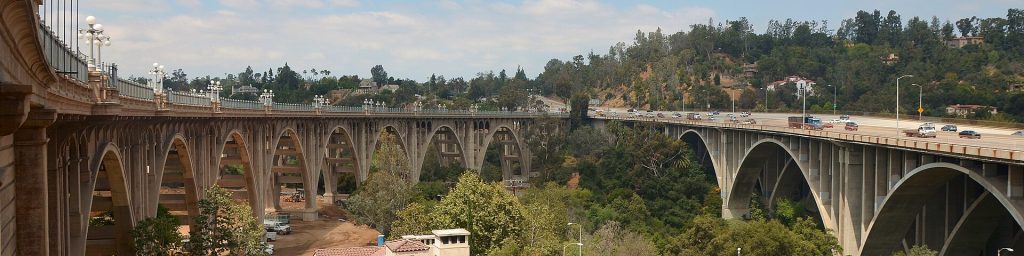
- Colorado Street Bridge — one of the city’s defining early-20th-century landmarks
- Holly Street Bridge — a key piece of the city’s transportation and canyon history
- Gamble House — Greene & Greene’s 1908 Arts and Crafts masterpiece and National Historic Landmark
- The Rose Bowl — the landmark tied to sports, spectacle and civic identity
- Millard House (La Miniatura) — Frank Lloyd Wright’s textile-block experiment
- Bentz House — another Greene & Greene work of Pasadena residential design
- Grand Avenue Mansions — grand estates from the winter-colony era
- Fenyes Mansion — the 1906 Beaux-Arts landmark designed by Robert Farquhar
- Park Place–Arroyo Terrace Historic District — central to Pasadena’s Arts and Crafts legacy
Across the route, the architecture runs from Craftsman and American Arts and Crafts to Beaux-Arts, Mission Revival, Spanish Colonial Revival, Tudor Revival and early modern experimentation — with Greene & Greene anchoring the story and Wright’s Millard House offering the counterpoint.
Good to know before you go
The company describes the walk as slow and conversational, with frequent stops for details most people pass every day — a change in materials, the relationship between a house and its garden, a bridge framed by the canyon. It is rated moderate: residential streets and sidewalks, with inclines and uneven terrain possible. Arrive 10 to 15 minutes early, and bring comfortable walking shoes, water, sun protection and light layers. Two honest caveats from the tour’s own FAQ: interior access to the Gamble House is not guaranteed — treat this as an outdoor architecture walk — and food and drinks are not included. Exact start and end times come with the session you select when you book.
Tickets
Tickets are listed from $19.99 on LA Explained’s shop page, where you pick your session. The company also sells walking-tour gift cards from $25, usable toward any of its public tours, and arranges private and corporate Pasadena tours on request. The tour has drawn write-ups from Time Out Los Angeles, LA Weekly and KCRW.
Sources: LA Explained shop — Pasadena Architecture & Historic Walking Tour product page, accessed Nov. 24, 2026.
Photo: cmglee, via Wikimedia Commons (CC BY-SA 4.0).
