A robot designed and built at Caltech has done something no machine has done before: it built part of a structure in orbit, all by itself, with no astronaut touching the controls. Caltech and the Defense Advanced Research Projects Agency (DARPA) announced the result on November 5.
The robot is called ASTRA — the Autonomous In-Space Tensioned Reflector Assembly — and it has spent the last six months in space working on a reflector antenna 1.4 meters across, built from composite fiber tubes, aluminum joints, and a Kapton reflective surface. Its manipulator picks up struts and joints from nearby dispensers and assembles them into identical sections, or bays, of a perimeter truss.
“This is the first time that a structure has been autonomously constructed in space,” said Sergio Pellegrino, the Joyce and Krent Kresa Professor of Aerospace and Civil Engineering at Caltech, who leads the ASTRA team. Pellegrino is also a senior research scientist at JPL, which Caltech manages for NASA.
A first, with an asterisk
ASTRA launched early on March 30, 2026, from Vandenberg Space Force Base, as one of 10 payloads aboard Momentus Inc.’s Vigoride 7 orbital vehicle, launched on SpaceX’s Transporter-16 mission. The payload, about one cubic meter in size, carried two prebuilt bays of the truss. Once in orbit, the team pushed those two bays out — and then the robot assembled a third bay on its own.
The full antenna design calls for 11 bays. With ASTRA’s mission ending in December, the team says it is unlikely to finish the whole truss — time limitations and a long list of small problems in orbit got in the way. But the demonstration did what a demonstration is supposed to do: it showed the assembly method works in space, and what to simplify and refine next.
Why building in space matters
The size of structures in space is limited by the size of rocket fairings. Until now there have been two ways to get a large structure into orbit: fold it up for launch and unfurl it, or send it up in pieces and have astronauts bolt it together. ASTRA points to a third option — build it where it will be used.
That matters because scientists want structures far bigger than any rocket can carry: enormous mirrors for space telescopes, large radio antennas, and very large solar arrays for harvesting power in space. DARPA’s program manager for the effort, Andrew Detor, put the scale bluntly: “By ‘very large,’ I mean hundreds of meters or kilometers in scale. Nothing approaching that scale can be achieved today.”
Pellegrino, also co-director of Caltech’s Space Solar Power Project, said the work could be useful “not only for astronomy and astrophysics but also for communications and other areas, such as building very large solar arrays for space solar power.”
The team behind the robot
The space demonstration is the third phase of DARPA’s Novel Orbital and Moon Manufacturing, Materials, and Mass-efficient Design (NOM4D) program, started in 2022. ASTRA is one of only two NOM4D projects to reach the orbital-demonstration phase; the other, led by the University of Illinois Urbana-Champaign, will test a method for hardening carbon tubes in space aboard the International Space Station.
The ASTRA payload was completed, tested, and delivered to Momentus in less than 12 months. The build commands were sent by team members Charles Sommer, Alan Truong, and graduate student Tara Venkatadri, and the outcomes were checked against photos downloaded from space. With only about seven or eight short windows of roughly 15 minutes each day to communicate with the system, the engineers built a twin of the spacecraft — a flight spare — to test fixes in Pellegrino’s Caltech lab before relaying them to orbit.
The robot was built at Caltech, and its team leader holds a research post at JPL — a Pasadena story twice over. The next step is a simpler, more refined design, and a bigger structure next time.
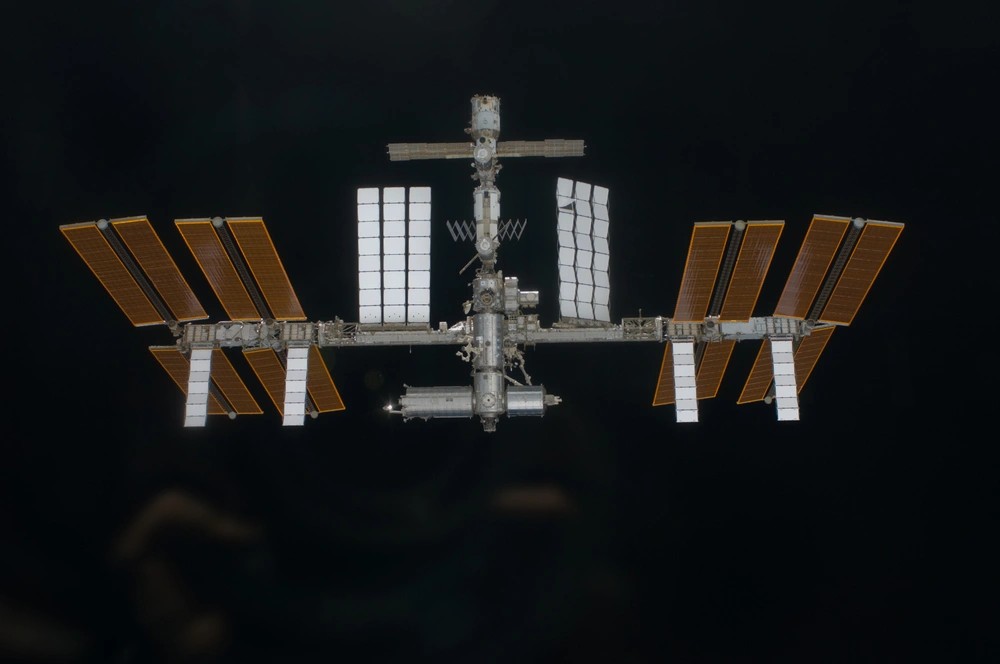
Photo: The International Space Station’s truss — the kind of large structure ASTRA is learning to build robotically in orbit. Photo: NASA.
Sources: Caltech News, “Caltech Robotic Space Demo Successfully Builds in Space,” November 5, 2026; DARPA, Novel Orbital and Moon Manufacturing, Materials, and Mass-efficient Design (NOM4D) program statement.
