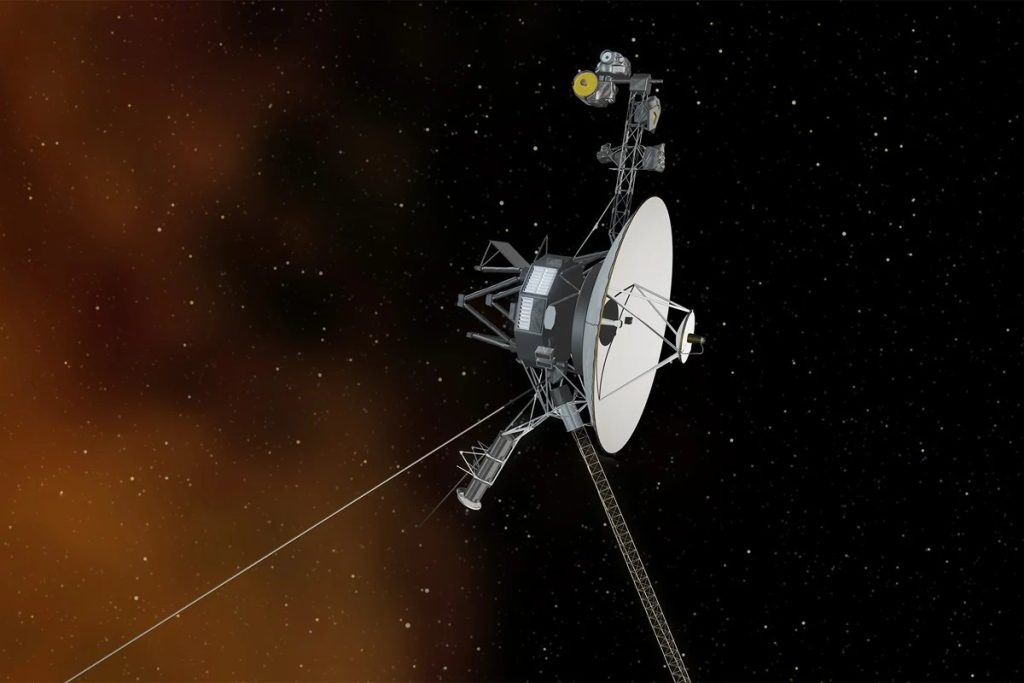
On Wednesday, November 18, a spacecraft built and operated in Pasadena will do something no human-made object has ever done: travel one light-day from Earth. NASA’s Voyager 1 will be more than 16 billion miles from home — and NASA’s Jet Propulsion Laboratory is inviting the whole planet to mark the moment.
A light-day is the distance light travels in a single day. Voyager 1, launched in 1977, has been flying for nearly 50 years, and it is now gathering science from interstellar space, beyond the Sun’s direct influence. The distance is hard to picture, which is exactly why JPL is making a public occasion of it.
Shine a light on Tuesday, November 17
The day before the milestone, NASA is asking everyone to take part in “Shine Bright for Voyager’s Light-Day.” The idea is simple: after sunset on Tuesday, November 17, create a symbolic wave of golden light encircling the planet — a flashlight, a porch light, a phone screen — and capture a photo or video of your light signal and share it on social media, tagging @NASA.
It is a small gesture for a very large number. But it fits the Voyager story: a mission that has always belonged as much to the public imagination as to the engineers who keep it alive.
The JPL discussion on Thursday, November 19
On Thursday, November 19, at 9 a.m. PST (noon EST), JPL will host a moderated discussion in its von Kármán Auditorium about the status of Voyager 1 and its twin, Voyager 2, the science the two probes are still gathering from interstellar space, and the challenge of keeping spacecraft operating for so long over such vast distances. A question-and-answer session with the audience will follow, along with a preview of the upcoming NASA+ Voyager documentary, planned for release in 2027 for the mission’s 50th anniversary.
The participants will be Nicky Fox, associate administrator of NASA’s Science Mission Directorate; Jonathan Lunine, JPL’s chief scientist and a professor of planetary science at Caltech; Suzanne Dodd, the Voyager project manager at JPL; Kareem Badaruddin, the Voyager mission manager at JPL; and Jamie Rankin, the Voyager deputy project scientist at Princeton University.
Media planning to attend in person must RSVP by Monday, November 16. Everyone else can watch the discussion live at nasa.gov/live.
Still going, on ingenuity
The milestone arrives on the back of some careful engineering. In an update on October 29, JPL reported that the Voyager 1 team had conserved power and resolved a brief communications pause, using creative workarounds to keep the nearly half-century-old spacecraft going. That is the quieter half of the Voyager story: not just how far it has flown, but how many times the people in Pasadena have found a way to keep it flying.
For a laboratory that is marking its 90th anniversary this year, the light-day is a fitting bookend — a spacecraft from JPL’s past, still doing science no other spacecraft can do, at a distance no other spacecraft has reached.
Photo: Artist’s concept of the Voyager 1 spacecraft in interstellar space. Photo: NASA/JPL-Caltech.
Sources: NASA/JPL News, “NASA Invites Media, Public to Join Voyager 1 One-Light Day Activities,” November 10, 2026 (NASA release M26-086); NASA/JPL, “What’s Up: November 2026 Skywatching Tips from NASA”; NASA/JPL, “NASA’s Voyager 1 Conserves Power, Resolves Brief Communications Pause,” October 29, 2026.
