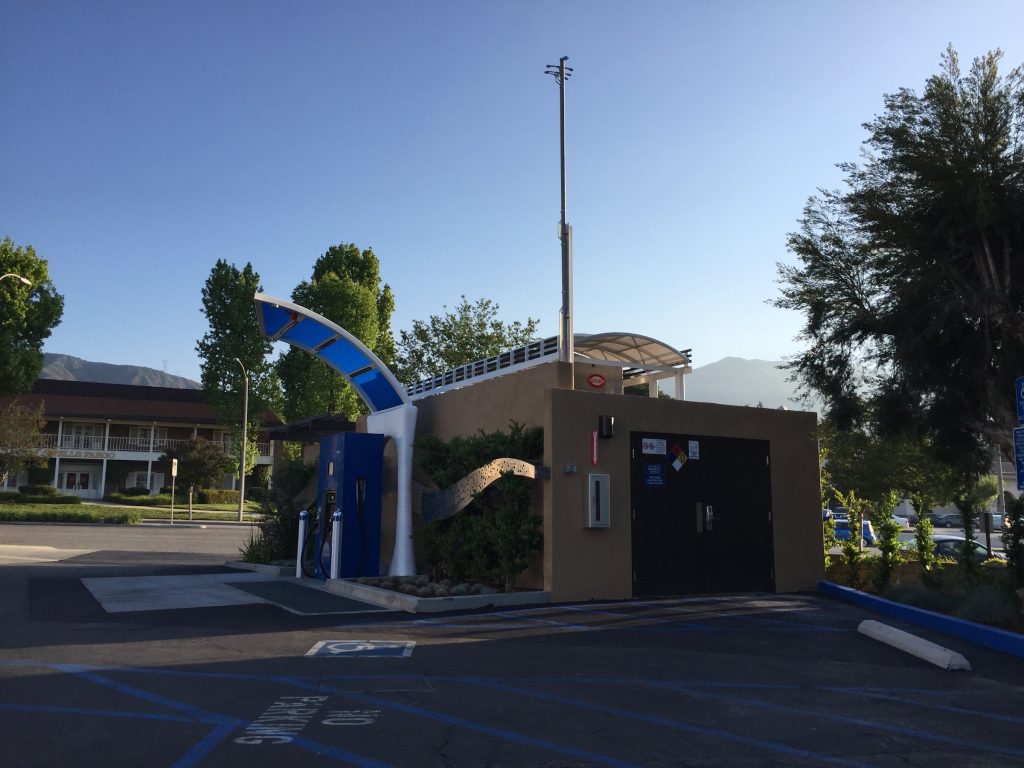
Featured photo: an existing retail hydrogen fueling station, photographed in 2016 — not the proposed Pasadena facility. Photo: Victor Caballero.
Two days after the City Council pulled the hydrogen items off its agenda without a word of explanation, the picture is getting clearer — and so is the size of what Pasadena has already signed up for. In a Pasadena Now report published this morning, City Manager Matthew Hawkesworth said officials are still determining whether further committee review is needed before Items 16 and 17 return. And Councilmember Rick Cole is now asking for two things the public has never been given: an independently reviewed comparison of the remaining options, and a separate accounting of what has already been spent. Since that accounting does not exist yet, here is the ledger as the public record stands.
Already committed: the buses
The single largest commitment is already rolling. In August 2025 the Council authorized roughly $32 million for 17 New Flyer hydrogen fuel-cell buses, and this past July the order already needed a $2.4 million cost-adjustment grant. The buses are in production. The fueling station that would serve them does not exist, has not been awarded, and — on the Department of Transportation’s own current timeline — would not finish construction until the end of 2029. The city committed to the vehicles first, and every later decision has been framed as necessary to avoid stranding them.
The station: a price that keeps moving
Item 16, the item held on Tuesday, would award $6,884,770 to Clean Energy Fuels Corp. for Phase 1 design-build services alone, for a station at 159 S. Kinneloa Avenue now priced above $23 million — about $6 million above the estimate presented earlier this year. The funding stack is principally a state TIRCP grant matched with more than $10 million in local Prop A and Prop C transit funds, plus $3 million taken from transit operating funds to cover the overrun. On the day of the meeting, staff added one more ask: a request to Metro for $13.9 million in Measure R funds. Grants pay to build the station; they do not pay for the fuel, operations and maintenance that follow for decades.
The program around it
The station is one piece of a zero-emission program the Department prices at $150.7 million, against the $100 million-plus in grants it cites — leaving tens of millions in local exposure. Councilmember Cole has estimated the five-year commitment across buses, station and fuel at roughly $70 million. The other half of the program, the Transit Operations and Maintenance Facility, shows why the estimates draw skepticism: priced at about $30 million in the FY 2022 capital program, it sits near $100 million in the current one, with staff’s September forecast at roughly $91 million and about $18 million still unfunded. The station itself has already slipped years: promised operational by 2027, the Department needed a 12-month extension from the California Transportation Commission — to December 31, 2026 — just to award the contract it has now failed to award.
The fuel: still unpriced
For all the money committed, the largest long-term cost remains unknown. Staff has never presented a contracted price for green hydrogen. The $8–$12 per kilogram figures in the public record are not an executed price or a guaranteed supply, and Item 16’s own recommendation defers the forecasted hydrogen-supply costs until staff returns for Phase II — after the design money is spent. The Department’s own May 2025 figures also put the hydrogen path’s emissions at 920 metric tons a year against 654 for battery-electric. Pasadena Transit’s one battery-electric bus, and its battery-electric Dial-A-Ride choice, are reminders that the state mandate requires zero-emission buses — it does not require hydrogen.
The cost nobody itemizes: staff time
Residents can find the contract figures above because contracts come to the Council. What appears nowhere in the public record is the resource cost of getting here: years of Department of Transportation staff time since the 2023 rollout plan, consultant work, grant-chasing, redesigns as estimates grew, and the preparation of repeated agenda reports for a contract that has now been extended, repriced and held. No total has ever been published. That is part of what Cole’s requested accounting — expenditures already incurred, recoverable amounts, cancellation liabilities and potential grant repayment, backed by written responses from manufacturers and funding agencies — would finally put on paper.
What happens next
Cole has asked the city manager and Municipal Services Committee Chair Justin Jones to commission the independent comparison before the project moves forward, covering four paths: build the station; use shared fueling infrastructure; transfer or exchange some or all of the 17 fuel-cell buses for battery-electric ones; or explore manufacturer-supported conversions. “I hope this approach can ensure both achieving a zero-emission fleet and ensuring we do not cannibalize transit operational funding for a speculative fueling strategy,” Cole said. At Tuesday’s meeting, resident P.A. Brown put the public’s version more bluntly, telling the Council he thinks “the city is choosing a Betamax option.”
The first test is tonight: the November 17 council agenda posts this evening. Whether Items 16 and 17 are on it — and whether the committee review and accounting Cole has requested come first — will say a lot about whether Tuesday’s silence was a pause or a strategy. AltaPasa’s earlier coverage: Hydrogen, Held (Nov. 11) and the open letter on Items 16 and 17.
Sources: Pasadena Now, “City Delays Hydrogen Bus Proposal as Questions Mount Over Technology’s Future” (Nov. 12, 2026); City Council agenda Items 16 and 17 and staff reports (Nov. 10, 2026); Items 16 and 17 supplemental correspondence packet; Department of Transportation figures as presented to the Council (2023 rollout plan; May and September 2025 presentations); FY 2022 and current Capital Improvement Program documents.
