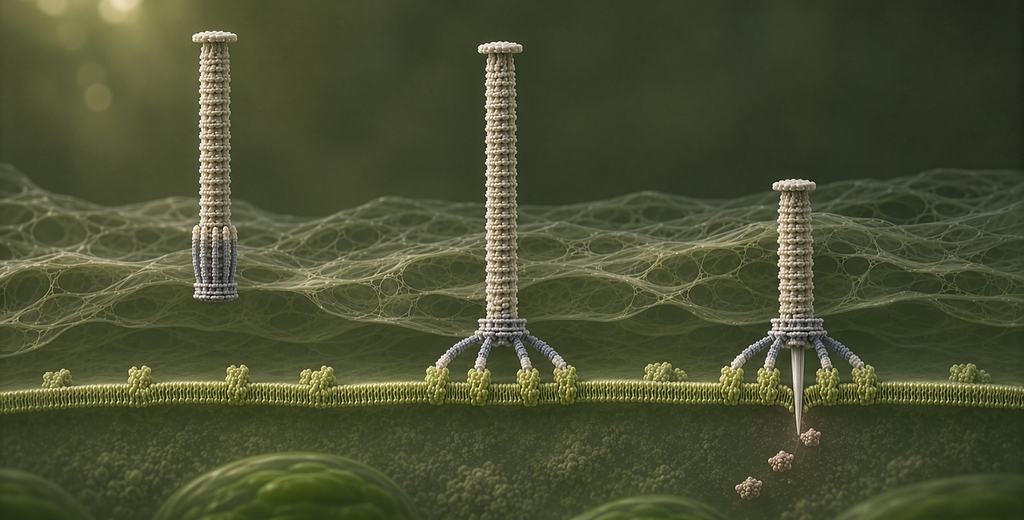
Getting a useful protein inside a plant cell is a stubborn problem. The cell wall and membrane that protect each plant cell are very good at keeping things out — including the molecular tools scientists want to use to study how plants grow, respond to stress, and resist disease. Now a team at Caltech has borrowed a weapon from bacteria and turned it into a delivery vehicle.
In a paper published November 18 in the journal Nature Nanotechnology, researchers led by Gozde Demirer, the Clare Boothe Luce Assistant Professor of Chemical Engineering, report that they have adapted tiny bacterial “nanosyringes” to recognize plant cells and inject working proteins directly into them. The system delivered enzymes that rearrange DNA and enabled targeted gene insertion in leaf cells — a new route for getting functional molecular tools into plants.
“One of the biggest barriers to studying and improving plants is getting useful biomolecules inside their cells,” Demirer says.
A syringe borrowed from bacteria
The delivery system is an extracellular contractile injection system, originally found in bacteria of the genus Photorhabdus. In nature, these bacteria release tiny syringes that deliver toxins into insect cells. The bacterial tail fibers recognize and attach to a target cell; then a surrounding sheath contracts, driving an inner tube through the cell membrane.
The Caltech team reprogrammed that machinery. They replaced the tail fibers’ natural binding region with a short chain of amino acids called flg22. Many plants carry an immune receptor called FLS2 on the surface of their cells that recognizes flg22 as a sign of bacterial infection — so displaying flg22 on the nanosyringes gave the tail fibers a molecular attachment point on plant cells.
The researchers tested the system in two common laboratory plants: Arabidopsis thaliana, a small flowering plant in the mustard family, and Nicotiana benthamiana, a relative of tobacco. In intact leaf tissue, where the cell wall remained a barrier, they loaded the nanosyringes with Cre recombinase, an enzyme that rearranges DNA, and supplied a specially designed genetic reporter that switches on a fluorescent signal when Cre acts on it. Fluorescence showed the injected enzyme was active inside the cells, not merely stuck to their surfaces.
Delivery depended on the intended receptor. When Arabidopsis plants lacked FLS2, Cre delivery did not happen. In plants with normal receptor levels, delivery reached up to 16 percent of leaf cells under the tested conditions. But when the scientists engineered plants to produce extra FLS2, about 75 percent of leaf cells lit up — suggesting that how many receptors a cell carries helps determine how efficiently a protein reaches its interior.
Beyond a single enzyme
The team also delivered a more complex genome-engineering protein called R2, which inserts genetic material at a defined location in a plant’s genome. After delivering R2 into Nicotiana benthamiana leaf cells, the researchers detected expression of the reporter gene and confirmed, using molecular measurements and DNA sequencing, that the genetic material had been inserted at the desired location.
That matters because most existing approaches to genetic modification in plants introduce DNA instructions that tell cells to make a desired protein. Delivering the protein itself bypasses that step, which reduces the chance of unwanted DNA ending up in the plant’s genome. With further development, the approach could also offer more control over when and where a molecular tool acts — whether the goal is a temporary change in cell behavior or a lasting change to the genome.
“We constantly hear about groundbreaking technologies in human medicine, but this feels like a massive step to bridge the gap between those breakthroughs and the agricultural sector,” says Mark G. Legendre, the lead author of the paper and a chemical engineering graduate student in Demirer’s lab. “While our platform still requires more development before it might be deployed in the field, we’re confident that we can eventually produce the first plant transformation system with cell-targeting and multifunctional capabilities.”
What comes next — and what it is not yet
The researchers hope to adapt the delivery system to recognize other receptors and deliver proteins to specific plant cell types. That could let scientists test how a particular protein affects growth, immunity, or stress responses in one part of a plant without changing every cell — and without first creating a new genetically modified plant for every experiment.
“By engineering what these particles recognize and what they carry, we are building toward delivering particular cargoes to particular cells when they are needed,” Demirer says.
The caveats are plain in the paper itself: the experiments were done in two laboratory plants, not in crops, and the system still needs more development before it could be used in the field. But as a proof of principle from a Pasadena lab, it opens a door that plant researchers have been pushing against for years — getting the tool itself through the wall, rather than sending in the instructions and hoping the cell builds it.
Sources: Caltech News, “Engineered Nanosyringes Open a New Route into Plant Cells,” November 18, 2026; Legendre et al., “An extracellular contractile injection system for receptor-mediated protein delivery into plant cells,” Nature Nanotechnology, November 18, 2026. Photo: Caltech.
