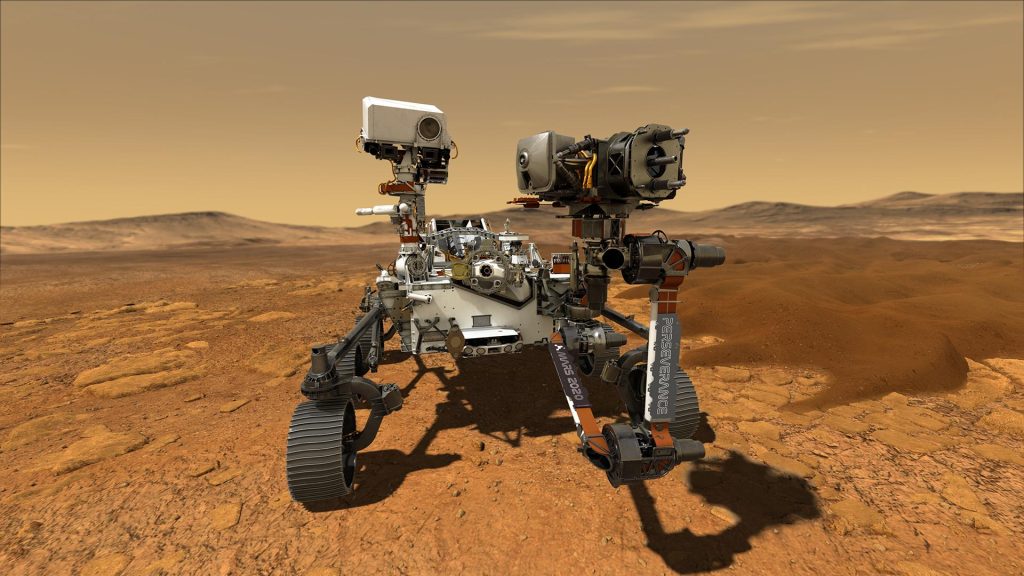
Two of the spacecraft run from NASA’s Jet Propulsion Laboratory in Pasadena hit trouble in the same week — and for one of them, the clock is now measured in weeks, not years.
NASA said on November 19 that its Perseverance Mars rover and the 2001 Mars Odyssey orbiter are both dealing with separate technical problems that have paused science operations on the two missions. The rover is stable and still in contact with Earth. The orbiter’s problem is more serious: a failed steering wheel has left it burning its limited fuel to stay pointed the right way, and the mission team estimates that fuel will last only one to two months.
Perseverance: a radio that stopped answering
The trouble on Perseverance began on October 30. When the rover powered on for the day’s work, its primary downlink radio did not send the usual series of electronic “heartbeats” to the rover’s main computer — the pings that confirm the radio is alive.
“The rover’s main computer continually listens for that ping,” said Perseverance project manager Steven Lee at NASA’s Jet Propulsion Laboratory in Southern California. “Every time it hears the ping, it resets a counter. However, if the radio stops sending the heartbeat due to a fault, after a certain number of missing heartbeats in a row, the computer swaps to the redundant one.” In this case, there were 25 missed heartbeats — about 100 seconds of silence.
The fault protection worked as designed: it powered off the unresponsive radio, switched to the backup, and put the rover into a protective safe mode, shutting down all non-essential systems. But after engineers recovered the vehicle and studied the diagnostic data, they found a second problem — the backup radio was transmitting at about half of its expected power output.
The team has stopped using both radios until it can determine what went wrong and whether one or both are safe to use again. In the meantime, Perseverance is talking to Earth directly through NASA’s Deep Space Network, using X-band communications over its high-gain antenna. That link works, but at a far lower data rate than the UHF radios, which normally send large volumes of data up to orbiters for relay. So science and instrument operations are paused to save bandwidth for diagnostic data — and the rover is not taking new pictures, which means the stream of raw images on the mission website has gone quiet too.
A team at JPL, which Caltech manages for NASA, is now investigating the backup radio first, then the primary. NASA says it hopes the rover could return to science by the end of November.
Odyssey: a steering wheel stops, and the fuel clock starts
The Odyssey problem is separate, and the stakes are higher. Between November 4 and 6, the orbiter went into safe mode. Engineers determined that one of its reaction wheels — the spinning wheels that steer a spacecraft by changing its angular momentum — had stopped spinning.
Odyssey has four reaction wheels, one of which already failed in 2013. At least three are needed to keep the spacecraft properly oriented. Without them, Odyssey must rely solely on its hydrazine thrusters to stay pointed — and after 25 years in orbit around Mars, the mission team estimates it has only enough hydrazine for one to two months of that. The team is still refining that fuel estimate.
There is a glimmer of hope: during testing, the malfunctioning wheel moved after being commanded, and further tests are underway to determine whether it can be recovered. The goal is for Odyssey to return to science and relay operations during the last week of November. Its science instruments are temporarily offline in the meantime.
Why this matters here
Both missions are run from Pasadena, and Odyssey in particular is part of the backbone of Mars exploration. Launched in April 2001 and in orbit around Mars since October of that year, it was designed to last just over two and a half years. It has now operated around the Red Planet longer than any other mission.
Odyssey created the first global maps of the composition of the Martian surface — maps that have become foundational for Mars geologists — and mapped water molecules in the top three feet of the surface, including buried ice that could be useful to the first astronauts on Mars. It has also served as the relay in NASA’s Mars Relay Network, sending back data from surface missions including the first post-landing images from the Phoenix lander and the Spirit, Opportunity, and Curiosity rovers.
It is also the third JPL spacecraft to report trouble in about a week: Voyager 1 stopped transmitting science and engineering data on November 14, though it remains in contact, and NASA says the team is confident that issue is temporary.
For now, the picture is one of two veteran missions in the shop at once — one with a communications problem engineers expect to fix, and one where the fix has to come before the fuel runs out. NASA says it will provide further updates as the teams learn more.
Sources: NASA Science, “NASA’s Perseverance, Odyssey Teams Investigate Technical Issues,” November 19, 2026 (updated November 20); NASA/JPL. Photo: NASA/JPL-Caltech.
