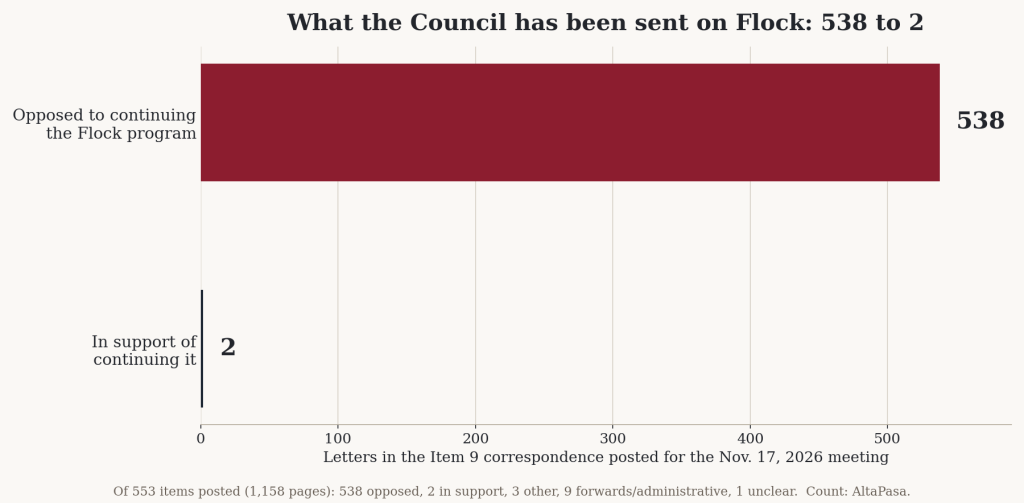
When the City Council takes up the Flock license-plate camera program tonight — Item 9 on the Tuesday, November 17, 2026 agenda, 6 p.m. in the Council Chamber at 100 N. Garfield Avenue — the members will be deciding against the largest written record any Pasadena surveillance question has drawn. The City Clerk has posted 1,158 pages of correspondence for this one item. AltaPasa read and counted every letter in the packet posted for tonight’s meeting. The result is not close.
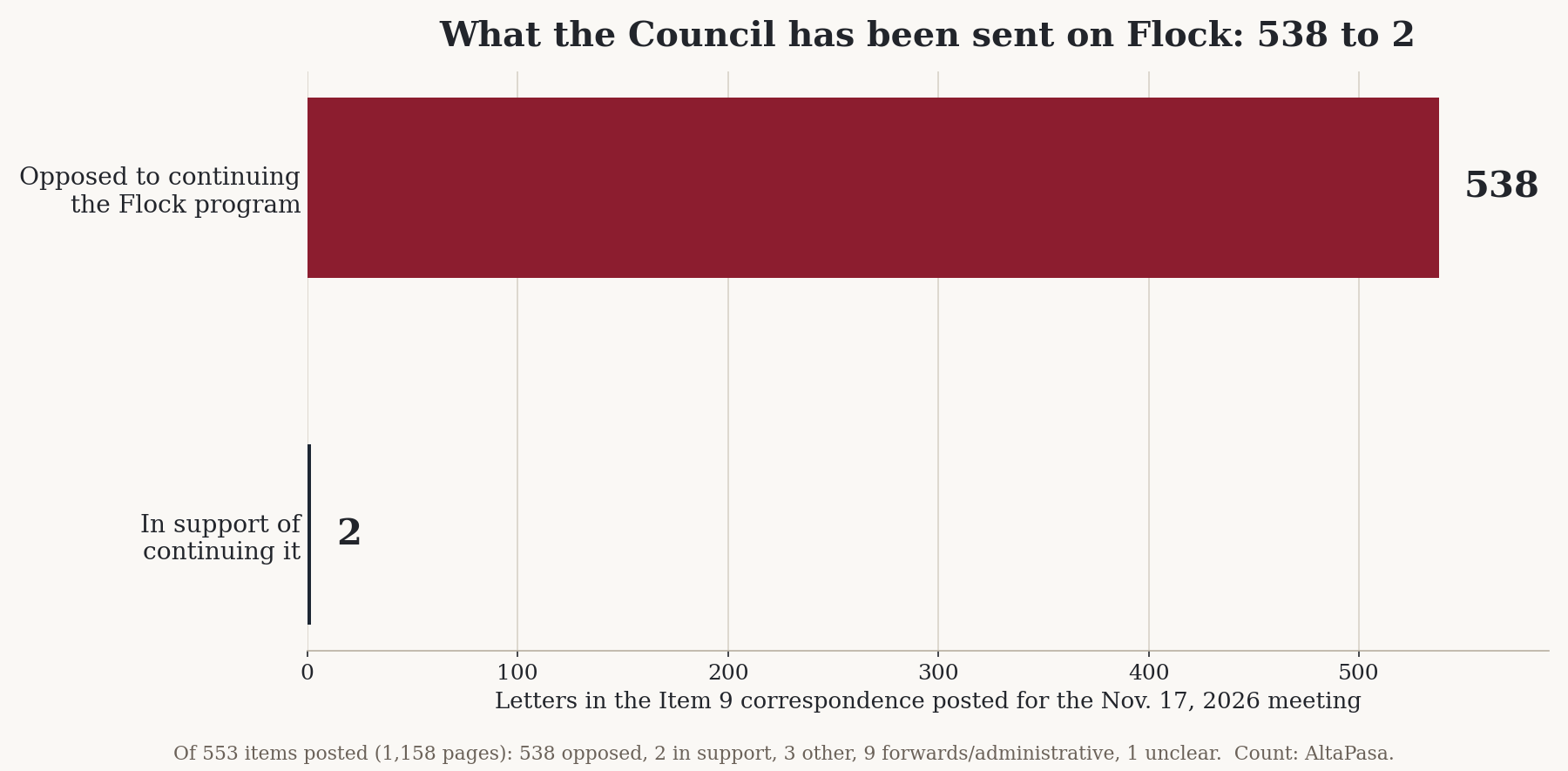
Of the 553 items in the correspondence posted for tonight, 538 letters oppose continuing the Flock program and two letters support continuing it. The remaining items are three letters that take no position on Flock, one whose position could not be determined, and nine forwards or administrative items bundled into the packet. (How we counted is explained at the end of this article.)
Update: After this article was first published, the City Clerk posted two additional supplemental correspondence files — Parts 3 and 4, another 119 pages — adding 17 letters submitted late this morning and into the early afternoon, past the posted noon written-comment deadline. Sixteen of the 17 oppose the program. The seventeenth, from a Community Police Oversight Commission commenter, attaches the Los Angeles Inspector General’s full review of the Los Angeles Police Department’s license-plate reader program and demands an independent audit of Pasadena’s. The figures in this article include the new letters.
Second update: Later in the afternoon, the City Clerk expanded Supplemental Correspondence Part 4 in place — the same file grew from 6 pages to 49 — adding 25 more letters submitted between 1:29 p.m. and 4:52 p.m. Twenty-four oppose the program. The twenty-fifth is a second letter in support: a resident who backs continuing license-plate readers with safeguards, while questioning whether Flock is the right vendor. One submission also attaches the Action Network campaign’s own tally, which reports 797 unique emails sent through the campaign as of early afternoon — 585 of them from Pasadena residents — more than the campaign letters the Clerk posted individually, so the posted packet appears to understate the campaign’s volume. The figures in this article include these letters as well.
What the letters ask for
The opposition letters are unusually specific. Most do not stop at ending the Flock contract: they ask the Council to cancel or let it expire and to commit to not replacing Flock with another license-plate reader vendor. More than 450 of the letters arrived through a single Action Network campaign page, under subjects like “Flock out of Pasadena.” The rest were written individually, and they range widely: a media-studies professor writing on surveillance research, a District 5 homeowner, Indivisible Alta-Pasadena writing as an organization, and one resident who attached the September 16, 2026 letter from U.S. Senators Adam Schiff and Ron Wyden pressing Flock’s CEO for answers about alleged abuse of the technology.
The arguments repeat across hundreds of letters: that the cameras amount to mass surveillance of people who are not suspected of any crime; that Pasadena data could reach federal immigration enforcement despite city and state restrictions; that the system has been hacked and misused elsewhere, including officers stalking women; that the cameras sit disproportionately in poorer neighborhoods — one commenter submitted an analysis concluding that 75% of the cameras are in “areas of persistent poverty”; and that the money would be better spent elsewhere. Several letters pointed to other cities that have walked away, including San Diego, whose council voted on Monday to stop using Flock cameras while facing a privacy lawsuit.
The packet also shows the timing of the response. The main correspondence file accumulated 394 letters between May 20 and November 11, 2026, as the question moved from the Public Safety Committee toward the full Council. Another 159 arrived in the final six days, November 12–17, after Vice Mayor Jess Rivas’s update told District 5 residents the item was coming — the last of them timestamped 4:52 p.m. today, a little over an hour before the meeting.
The letters in support
The first of the two letters supporting continuation came from former Mayor Bill Paparian, who recommended that the Council continue the program through its authorized extensions while directing staff to adopt tighter, binding safeguards on retention, sharing, placement, and reporting — the position he laid out in his August 31, 2026 Pasadena Now guest essay, “Pasadena’s Flock Cameras: Keep the Tool, Tighten the Screws.” Paparian wrote that the program’s public-safety results are real, and so are the privacy and equity concerns. His letter also supplies a figure for the earlier round of this debate: the 365 letters submitted for the May 20, 2026 Public Safety Committee meeting, 276 of them from Pasadena residents. AltaPasa’s own count of that posted file found 366 letters, 359 of them opposed and none in support.
The second support letter, signed “p brown” and timestamped 4:46 p.m., backs ALPR technology “with appropriate safeguards” — comparing the cameras to insurance, worth confirming before an incident — while saying whether Flock is the best company “remains an open question.”
Across every correspondence file posted under Item 9 — tonight’s packet plus the March 18 and May 20, 2026 committee files — the year’s Flock correspondence totals 933 letters.
The Police Department’s case
Against that record, the formal staff recommendation is narrow: the agenda report asks the Council only to “provide policy direction” on the program through 2028. The contract itself (No. 32679, authorized July 17, 2023, at $631,350) is paid through February 2027, and the 2023 Council delegated authority to extend it to the City Manager through February 2028, with extensions capped at $152,500 from money already budgeted. That means doing nothing tonight also has an effect: the program continues on staff’s existing authority.
The department’s substantive case arrived yesterday, in a supplemental memorandum from Chief Eugene Harris dated November 16, 2026, attaching a full review of the program’s agreements, operations, data sharing, privacy safeguards, and public-safety impact. The review lays out six options for the Council, from continuing the program as it stands, to continuing with enhanced oversight, modifying retention or sharing, restricting outside agencies’ access, seeking a different vendor through an RFP, or discontinuing the program altogether. The department recommends continuation.
Its headline numbers:
- In 2025, Pasadena recovered 89 stolen vehicles; 27 of them — more than 30 percent — came directly from Flock alerts, representing about $700,000 in recovered property, the largest single source of recoveries the department identified.
- The department credits ALPR leads in a January 2026 Ashtabula Street homicide investigation that produced an arrest and confession within about 12 hours, and in robbery, road-rage, strong-arm robbery, arson, and sexual-assault investigations.
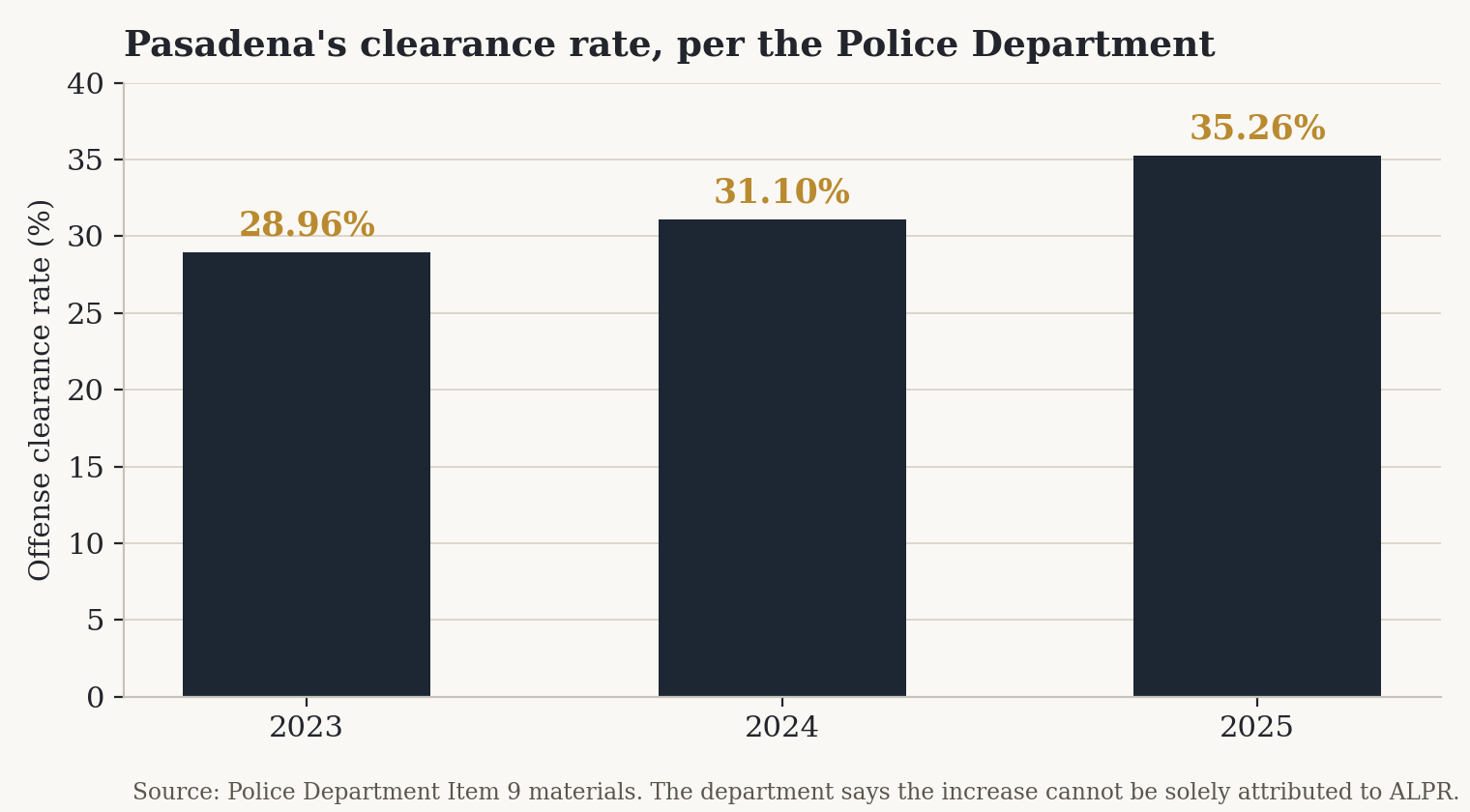
- Pasadena’s overall offense clearance rate rose from 28.96% in 2023 to 35.26% in 2025 — with the department’s own caveat that the increase cannot be solely attributed to ALPR.
The review also puts a price on stopping: the department calculates that discontinuing the existing agreement now would carry about $216,041 in financial impact — roughly $152,500 in remaining contractual obligations plus $63,541 already paid toward services that would no longer be used. Separately, the department confirms that an 11-camera expansion of the Flock network, from 61 to 72 cameras, was already planned and partly funded by a roughly $34,390 federal Byrne JAG grant; deployment has been postponed pending the Council’s direction, and walking away from it would forfeit the grant money. The expansion order totals $133,389.96 over four years. The review also discloses that, apart from the 61 Flock cameras at roughly 20 intersections, the department operates 11 fixed Motorola Vigilant ALPR cameras in the Rose Bowl corridor, which were outside the scope of the Independent Police Auditor’s Flock review.
On the privacy questions that dominate the letters, the department points to its 2025 audit, in which it reviewed all 5,095,190 records in its network-audit logs and found no out-of-state agency access and no indication Pasadena data was used for immigration or reproductive-health enforcement; about 70% of searches involved a specific license plate already connected to an investigation. The Independent Police Auditor’s review likewise found the Flock program operating consistently with California law and department policy. Pasadena retains routine ALPR data for 30 days; Flock announced in August 2026 that it was lowering its recommended default to 7 days, and the review notes a shorter period is available for the Council to consider. A modernization of the department’s ALPR policy, Policy 462, is in draft. The review also repeats the point in the department’s community briefing fact sheet: a fixed ALPR network would be, in its words, an important foundation for the future Active Intelligence Center the department has discussed — which is why tonight’s vote is about more than the current contract. AltaPasa covered that briefing, and how to comment tonight, here.
What to watch tonight
The Council is not voting on a contract tonight; it is giving direction. The live questions are whether a majority forms around one of the department’s six options — and if the answer is continuation in some form, whether the Council attaches conditions the department has not adopted on its own: a shorter retention period, tighter sharing rules, an independent audit regime, or a date to revisit the program before the February 2028 extension horizon. The correspondence count says where the written public stands. Tonight’s speakers, and the seven votes at the dais, will say the rest.
How AltaPasa counted: every item in the Item 9 correspondence files posted by the City Clerk for the November 17, 2026 meeting — Correspondence Parts 1–8 and Supplemental Correspondence Parts 1–4, as posted by late afternoon on November 17 (Part 4 was expanded in place after it first appeared; this count uses its final, 49-page version) — was classified by the position stated in the letter itself. Form letters submitted through the Action Network campaign were counted individually, as submitted. Nine items were forwards, duplicates, or administrative material rather than comment letters (including the City Clerk’s forwards and a councilmember’s constituent update included in the packet); One letter that the Clerk posted in two different files was counted once. Three letters took no position on Flock; one letter’s position could not be determined from its text. Letters submitted after the final supplemental files were posted are not included. One of the 538 letters counted in opposition is the public comment submitted by AltaPasa’s publisher, Victor Caballero; it is counted the same as every other letter. Sources: City of Pasadena, November 17, 2026 City Council agenda and Item 9 documents, including the Agenda Report, Attachment A, and the November 16, 2026 supplemental memorandum from Chief Eugene Harris.

1 Comments