Tonight, Friday, November 20, Caltech’s Cahill Center for Astronomy and Astrophysics hosts a free public lecture on a question most of us have never thought to ask: what did the Big Bang sound like?
The speaker is Rana Adhikari, a professor of physics at Caltech who works on gravitational waves, precision measurement, and fundamental physics. His talk, “What Did the Big Bang Sound Like?”, runs from 8:00 to 8:45 p.m., followed by a panel question-and-answer session and guided stargazing with telescopes until 9:45 p.m. It is the 128th lecture in Caltech’s Stargazing Lecture series, and it is free and open to all. No reservations are needed.
Listening past the first light
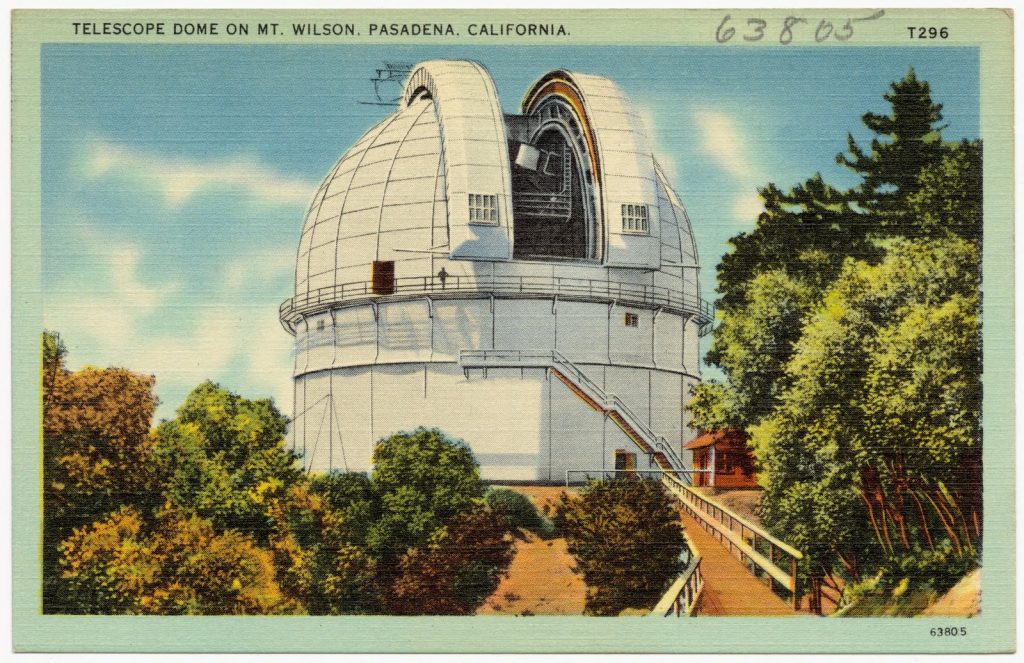
The talk starts close to home — up the hill in Altadena. Almost a hundred years ago, astronomers on Mount Wilson discovered that the universe is expanding. Trace that expansion backward and you arrive at the Big Bang, whose faint afterglow still fills the sky.
But that light only takes us back so far. For its first 380,000 years, the universe was a glowing fog that no telescope can see through. To look earlier, Adhikari will argue, we may need to listen instead — for gravitational waves, the ripples in space and time that Einstein predicted and that Caltech’s LIGO first detected in 2015. The talk explores how we might catch the faint echo of the universe’s first moments.
Along the way, he will also take up how gravity bends time — why, as Caltech puts it, your head ages faster than your feet — and why, years after many thought cosmology was “solved,” it remains full of mysteries: what are dark matter and dark energy, and why does space have three dimensions?
If you go
What: Stargazing Lecture — “What Did the Big Bang Sound Like?”, with Rana Adhikari, professor of physics at Caltech
When: Friday, November 20, 2026, 8:00–10:00 p.m. Lecture 8:00–8:45 p.m.; panel Q&A and guided stargazing 8:45–9:45 p.m.
Where: Cahill Center for Astronomy and Astrophysics, Caltech, Pasadena
Cost: Free and open to all; no reservations needed. Stay as long as you want.
Watch from home: The lecture and Q&A will also be live-streamed on YouTube at https://www.youtube.com/live/i–KsRVsbuk
The evening is family friendly, and the talk is pitched at a public level — no science background needed. Stargazing is weather permitting, but the lecture and Q&A happen regardless. The forecast for tonight calls for clear skies, about 55 degrees at 8 p.m., so the telescopes should get their chance.
The series runs roughly monthly. Last month’s lecture, on October 23, featured Anjali Tripathi on how astronomers find planets they cannot see. Tonight’s is a good one to catch in person: a Pasadena physicist, a question that starts on Mount Wilson, and a sky that, for once this week, looks like cooperating.
Sources: Caltech Astronomy, Stargazing Lecture event page (Nov. 20, 2026); Caltech Division of Physics, Mathematics and Astronomy events calendar; weather.com hourly forecast for Pasadena, Nov. 20, 2026.
