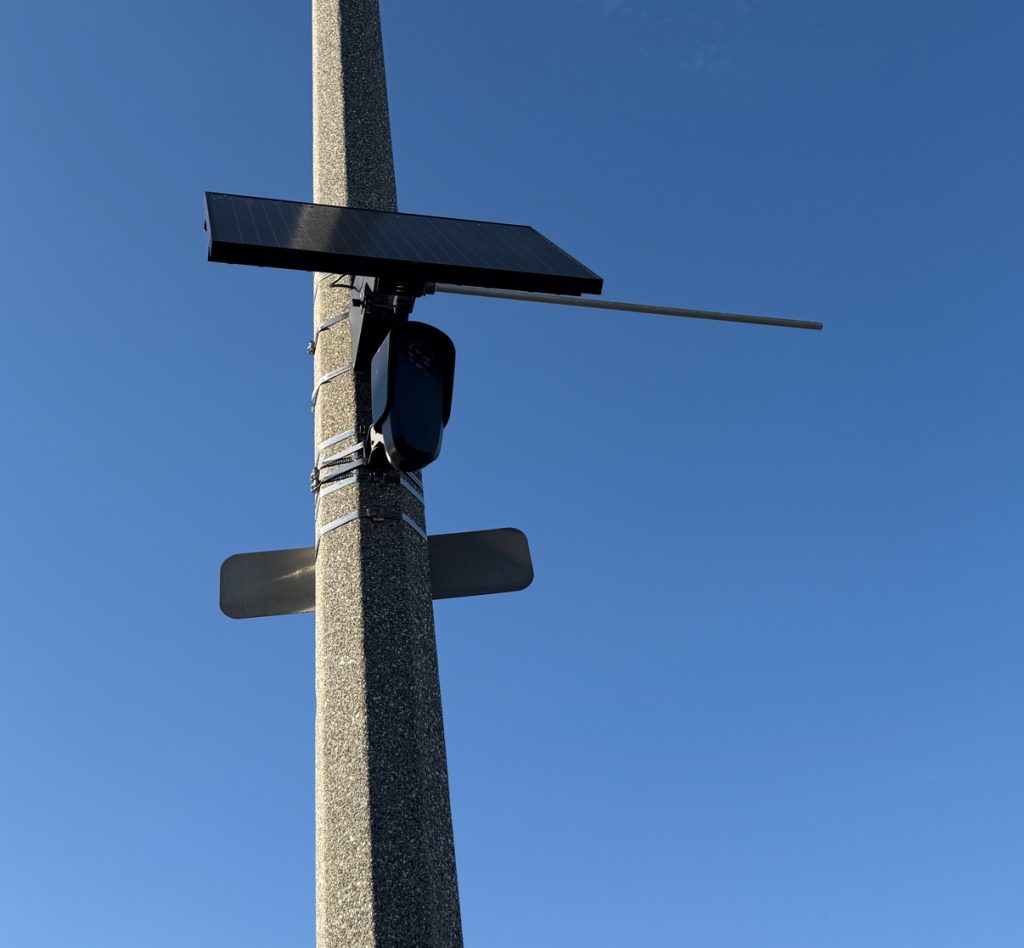
Featured photo: a Flock Safety camera in Pasadena. Photo: Victor Caballero.
Tuesday’s Flock discussion arrives with a paper trail: a four-page staff report, a 12-page police “Community Briefing Fact Sheet,” the May 20 Public Safety Committee minutes, and eight parts of public correspondence running to roughly 800 pages — on top of the two committee correspondence bundles. We read the packet. Here is what it actually says, what it argues, and what it leaves out.
What Tuesday is — and is not
Item 9 asks the Council to “provide policy direction” on the ALPR program through 2028. It is not a contract vote, because under the Council’s 2023 action it doesn’t need to be: Contract No. 32679 with Flock Group Inc. (not to exceed $631,350, authorized July 17, 2023) delegated renewal authority to the City Manager. The service is paid through February 2027; the extensions that carry it to about February 2028 cost up to $152,500 from existing appropriations. The Police Department’s recommendation, in its own report, is continuation. Absent direction to the contrary, the program continues on rails.
The staff report’s safeguards — and its one big disclosure
The report recites the program’s rules: access limited to trained, authorized personnel; searches require a documented investigative purpose; Pasadena retains data 30 days and controls sharing; nationwide and out-of-state sharing is disabled; searches for immigration enforcement or reproductive-health investigations are prohibited; access logs are reviewed and audited. It also explains the alarming free-text search reasons residents found in Flock’s Network Audit: outside agencies’ free-text entries appeared on Pasadena’s audit page whether or not Pasadena shared data with them — and Flock has since replaced free text with a standardized “Offense Type” dropdown.
The disclosure with real policy weight is this: in August 2026, Flock itself cut its recommended default retention from 30 days to 7 days. The change is not automatic for existing customers, and the report frames Pasadena’s choice — 7 versus 30 days — as a balancing decision for the Council. Pasadena still keeps 30.
The fact sheet’s case: results, with caveats attached
Attachment A, the Department’s “ALPR Community Briefing Fact Sheet,” is the advocacy document. It notes Pasadena has used ALPR since 2009 and expanded the network in 2023–24 after a series of shootings, when conventional cameras couldn’t read plates at night. It then walks through some two dozen cases: a January 2026 homicide on Ashtabula Street where ALPR helped identify and arrest a suspect within about 12 hours; an October 2026 suspicious-death investigation where detections helped locate a driver — and clear him, the sheet emphasizes, when investigators determined no foul play occurred; a five-year-old abducted by his father and recovered in Washington State; a church arson; missing adults and juveniles found. It closes the examples with a retrospective: 13-year-old Iran Moreno, killed in his bedroom in November 2021, whose case took nearly four years to solve — a review concluded today’s camera locations might have produced leads within hours.
Its headline numbers: in 2025, ALPR alerts directly led to 27 of Pasadena’s 89 stolen-vehicle recoveries (more than 30%), about $700,000 in recovered property. The city’s overall clearance rate rose from 28.96% (2023) to 35.26% (2025). Shootings fell from 58 (2023) to 29 (2025) and murders from 6 to 1. To its credit, the sheet attaches the caveat twice, in its own words: clearance rates “cannot be solely contributed to ALPR,” and crime trends “reflect many factors.” Looking ahead, the sheet argues ALPR is a foundation of the Department’s planned Active Intelligence Center and will matter for LA28, when the Rose Bowl hosts Olympic soccer finals and the Aquatics Center hosts diving — and it recommends keeping coverage through at least September 2027 to avoid an investigative gap during any transition.
What the packet does not contain
Read closely, three absences stand out. First, no independent effectiveness analysis: the results are the Department’s own selected examples, and the July 2026 Independent Police Auditor review was a compliance audit — did PPD follow the law and its own policy — not a study of whether the program reduces crime. Second, no error accounting: the packet gives no false-alert or misread figures. Third, no alternative priced: despite members of the Public Safety Committee raising other vendors in May, the packet contains no comparison of Flock against any competitor or against a no-ALPR baseline. The Council is being asked for direction with one option documented.
The correspondence: 800 pages, running one way
The eight correspondence parts attached to Item 9 total roughly 811 pages, and Pasadena Now’s characterization matches our own read: they are almost entirely emails urging the Council to end the contract. The great majority are a single Action Network form letter — subject line “Flock out of Pasadena” — urging the Council to “put safety over surveillance and cut ties with Flock,” citing the ACLU and EFF and listing cities that have ended their Flock contracts. Interspersed are individual letters: one Northwest Pasadena resident’s four demands (disable and remove the cameras, cancel the contract, no replacement vendor, fund community-based safety), and another resident’s submission of the September 16, 2026 oversight letter from U.S. Senators Adam Schiff and Ron Wyden to Flock’s CEO, pressing the company on reported abuses of its network. In the May 20 committee record (Attachment B), the Clerk reported 365 letters received — 276 from Pasadena residents — and the meeting heard 17 speakers concerned about the cameras against one in support. We found no letter in the November packet arguing to keep the program.
Where the committee left it
The May 20 Public Safety Committee discussion that sent this to the full Council ended split four ways: Rivas for termination without a replacement (or, failing that, sharp reductions); Hampton for switching to a different vendor; Jones concerned about data sharing with ICE and open to a new vendor with amended retention; Madison for continued use with adjustments. Tuesday’s full Council inherits exactly that spread — with a staff recommendation for continuation and a delegated renewal that needs no one’s permission.
What to watch Tuesday night
Three tells: whether any motion goes beyond “direction” to an actual instruction not to exercise the option; whether the 7-day retention the vendor itself now recommends gets moved as a minimum condition; and whether anyone moves to take the 2023 delegation back, so the next decision about license plate readers in Pasadena is made by the people Pasadena elected to make it.
The misuse Pasadena is being warned about just happened in San Diego
Pasadena’s packet asks residents to trust that policy safeguards will keep a plate database from being misused. This week, California’s second-largest city supplied the counterexample. On Thursday, San Diego Councilmember Raul Campillo — a former prosecutor who had supported the cameras — withdrew his support and called for the system to be suspended, after internal-affairs documents posted by the city showed that San Diego police investigators had run the license plate of an alleged domestic-violence victim through the city’s Flock database. The investigator was probing an officer who had answered the woman’s domestic-violence call in February 2025 and was suspected of beginning a relationship with her; both plates were searched to see whether their vehicles had been in the same place at the same time. The searches found nothing. The officer later admitted the relationship and is no longer with the department.
The department does not concede misuse: a spokesperson confirmed internal-affairs investigators have used the system in six misconduct investigations and said investigating officer misconduct “falls within those authorized uses.” Campillo’s response is the sentence Pasadena’s Council should sit with: learning that the department “used ALPRs inappropriately to surveil one of their own and a member of the public calls the entire program into question.” He is the sixth San Diego councilmember now seeking to end the cameras’ use — the council’s Budget Committee (Elo-Rivera, Foster, Lee and Moreno) voted unanimously last month to rescind the city’s approval and end its $2 million Flock contract, and Councilmember Whitburn withdrew his support — a veto-proof supermajority arrayed against a mayor who backs the system. San Diego’s full council takes up the cameras on Monday. That city runs 500 cameras to Pasadena’s 61, with the same 30-day retention — and it is also defending a September civil-rights lawsuit over the database and a federal suit by a man who says he was jailed for a month after an ALPR search targeted the wrong vehicle.
The lesson for Tuesday is not that Pasadena’s officers are San Diego’s. It is that “the rules prevent misuse” is a weaker guarantee than it sounds — in San Diego, the department’s position is that the rules permitted the use that ended the program’s political support. Safeguards written as policy stretch exactly as far as the people applying them decide they stretch. Pasadena’s packet, read closely, offers the same kind of safeguard — and Item 9 is the one night the Council can choose a stronger one.
Sources: City Council agenda and Agenda Report for Item 9 (Nov. 17, 2026); Attachment A, PPD ALPR Community Briefing Fact Sheet; Attachment B, Public Safety Committee minutes (May 20, 2026); Correspondence Parts 1–8 and Public Safety Committee correspondence bundles posted with Item 9; Pasadena Now, “City Council to Weigh Future of Pasadena Police License Plate Reader Program” (Nov. 13, 2026); IPA Review of PPD ALPR compliance (July 9, 2026); San Diego Union-Tribune, ‘Alleging misuse of Flock data by SDPD, sixth council member calls to turn surveillance system off’ (Nov. 12, 2026).

2 Comments