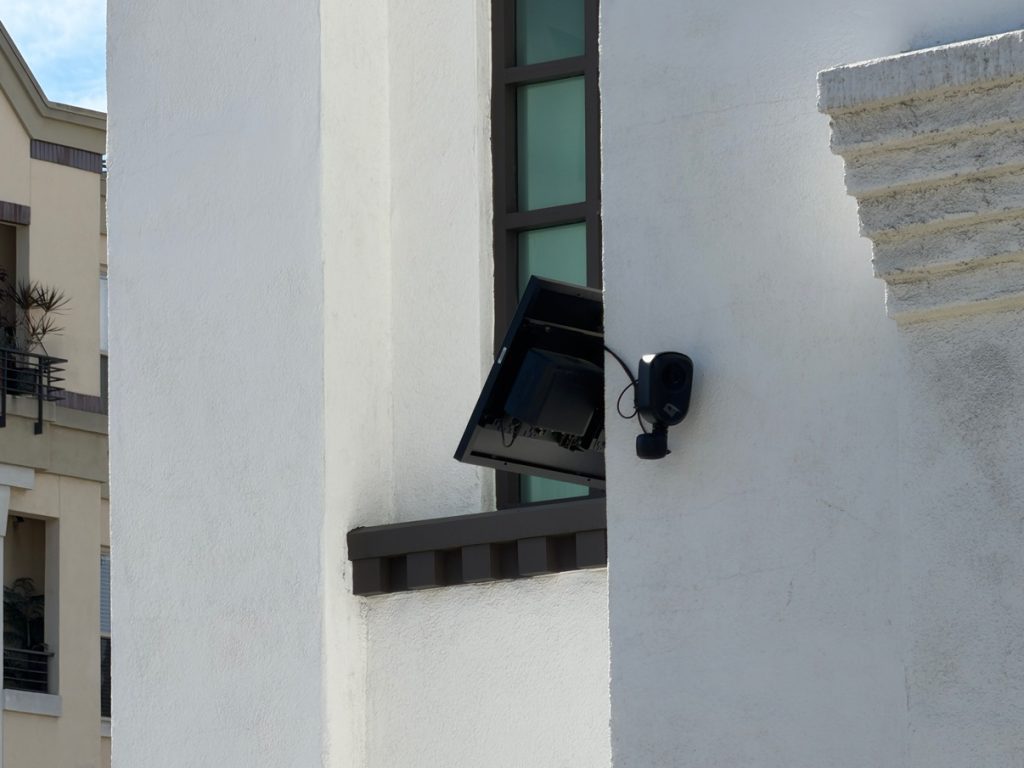
Look up at the Total Wine building on the corner of Oak Knoll Avenue and Colorado Boulevard, and there it is: a small black camera with a solar panel — Flock Safety’s standard license-plate reader — bolted not to a city pole but to the wall of a private building, aimed at the intersection. It photographs every car that passes. And as far as any public record shows, it does not exist.
Featured photo: the camera on the Total Wine building, Oak Knoll and Colorado. Photo: Victor Caballero.
The search for a record
Start with the city’s own disclosures. Pasadena’s Flock transparency portal publishes how many cameras the Police Department runs (61), how long plate data is kept (30 days), how many vehicles the cameras recorded in the last month (about a million) and which agencies may search the data. What it does not publish is where a single camera is.
The Independent Police Auditor’s review of the program, issued in July, describes the cameras as “fixed-position cameras installed in public locations throughout the City,” and analyzes their placement by council district. It does not list addresses, and it does not mention cameras mounted on private buildings.
The only location-level record of Pasadena’s cameras anywhere is crowdsourced: volunteers who spot cameras and pin them to OpenStreetMap, the data behind the DeFlock maps and a Pew Research Center analysis published November 9. That map shows 62 reported plate readers around Pasadena — including one whose operator is listed simply as “private.” As of today, it shows no camera at Oak Knoll and Colorado, and none within 500 meters of the corner; the nearest mapped Flock cameras are about a kilometer west, in Old Pasadena. Nationally, Pew found, the crowdsourced map identifies an owner or operator for only 12 percent of the cameras on it.
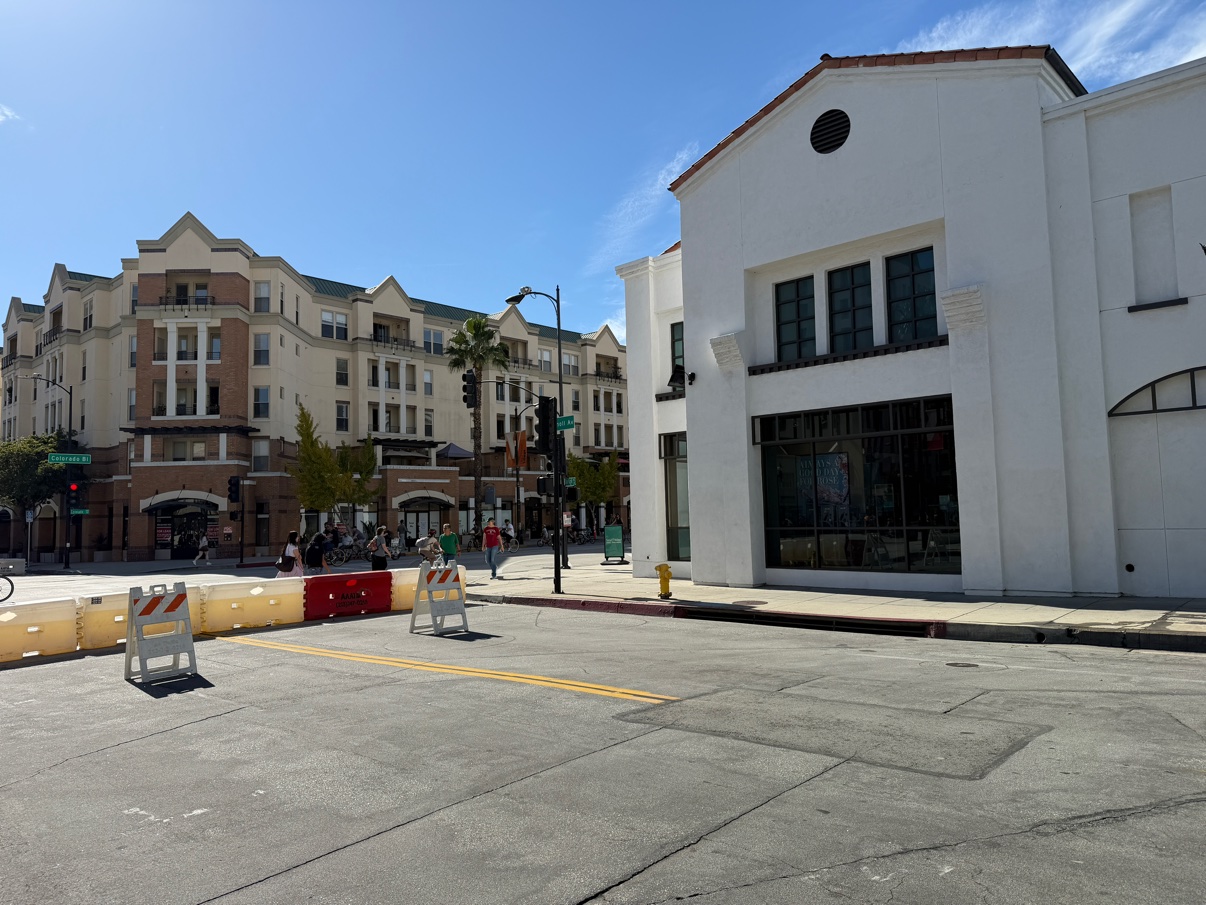
The corner of Oak Knoll and Colorado during CicLAvia on Sunday. The camera is on the wall above the storefront, facing the intersection. Photo: Victor Caballero.
Whose camera is it?
From the sidewalk, there are two possibilities, and no public document distinguishes between them. It could be one of the city’s 61, mounted on private property under an agreement that has never been described in a staff report. Or it could be the store’s own camera. Flock sells the same hardware to businesses, homeowners associations and schools — the company counts more than a thousand business customers — and private owners decide for themselves whether to share their cameras’ data with law enforcement. State law requires private plate-reader operators, like police, to maintain a usage and privacy policy. It does not require anyone to publish a list of them.
If the camera is private and its data is shared, its reads are not in the city’s 61, not in the transparency portal’s counts as a city camera, and not within the scope of the auditor’s review of the Police Department’s program. If it is the city’s, then the program’s cameras are not all in “public locations” in any ordinary sense, and the terms under which a business hosts one — rent, access, notice to customers — are nowhere in the public record.
A count nobody can complete
The official numbers already do not reconcile. The portal says 61 Flock cameras. The auditor’s addendum disclosed 11 more city plate readers — a legacy Motorola Vigilant system in the Rose Bowl corridor — that appear in no portal. The department has proposed 11 additional Flock cameras, whose status is unconfirmed. One index of the crowdsourced map counts 80 documented readers in the Pasadena area. And none of those figures includes privately owned cameras, in Pasadena or anywhere else. Ask how many plate readers record Pasadena’s streets tonight, and the honest answer is that nobody outside the network knows.
What Tuesday should ask
Item 9 on Tuesday’s council agenda asks for policy direction on “the program” through 2028. The questions this camera raises belong in that discussion: How many of the city’s cameras are mounted on private property, and under what agreements? Does the Police Department receive data from privately owned Flock cameras inside Pasadena — and if so, from how many, under what policy? And will the city publish an address-level inventory of its own cameras, so that the next one does not have to be discovered by looking up?
The camera at Oak Knoll and Colorado will record the evening commute tonight, whoever owns it. Where its data goes, who can search it, and how long it is kept — no public record says.
Sources: Pasadena Police Department Flock transparency portal (camera count, retention, detections); Independent Police Auditor review of the ALPR program (July 9, 2026) and addendum; OpenStreetMap / DeFlock crowdsourced camera data, checked November 15, 2026; Pew Research Center analysis of Flock camera locations (November 9, 2026); Flock Safety statements on private-sector customers and data sharing (September 2026). Photos: Victor Caballero, November 15, 2026. Related: Item 9, Read Closely; The Other Sensor Network: ShotSpotter.

1 Comments