On Tuesday night the City Council will spend hours deciding the future of Flock’s license-plate cameras. Pasadena runs a second always-on police sensor network that will not be on the agenda — microphones, not cameras, listening for gunfire over three square miles of the city since February 2022. In authorized dollars it has cost more than the Flock contract now under debate, and it has never had a public reckoning like the one Flock gets on November 17.
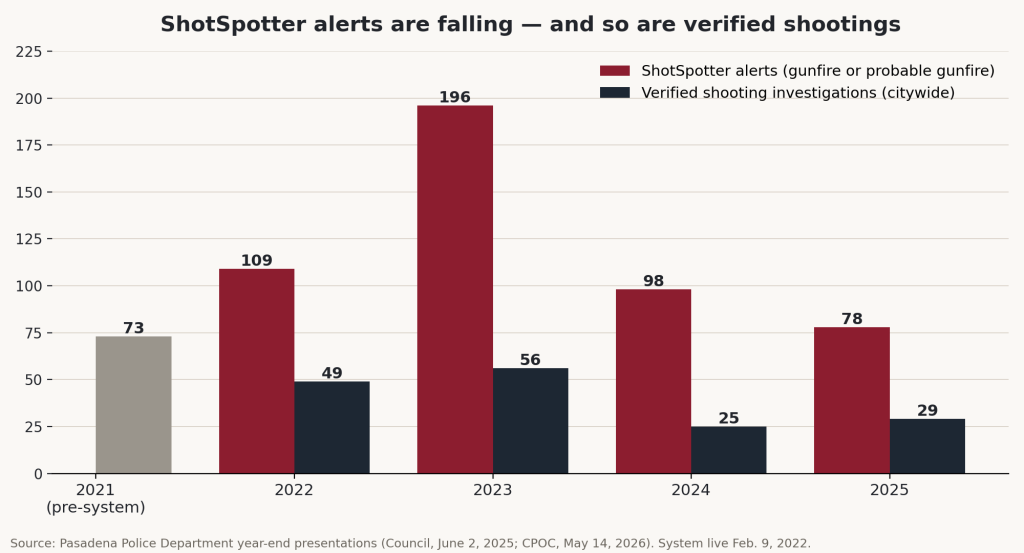
Featured chart: ShotSpotter alerts and verified shooting investigations in Pasadena, from the Police Department’s own year-end presentations.
Ears instead of eyes
ShotSpotter is a grid of acoustic sensors. When several of them hear a loud, impulsive sound, the system triangulates it — the city was told, to within an 82-foot radius — and sends a short audio clip to analysts at the company’s Incident Review Center, who decide whether it was gunfire before an alert reaches officers, in under a minute. The vendor, ShotSpotter, Inc., renamed itself SoundThinking in April 2023 as it broadened into other police software; the gunshot product kept the ShotSpotter name. One footnote for Tuesday: SoundThinking now also sells its own license-plate reader, PlateRanger — South Pasadena evaluated it this August as a possible Flock replacement.
Pasadena’s deal
The Council authorized ShotSpotter on October 4, 2021 — a three-year pilot, sole-source, not to exceed $640,000 — after a Public Safety Committee meeting at which Councilmember John J. Kennedy read the Chicago inspector general’s findings into the record and seven residents spoke against the system to one in support. Kennedy’s asks — a short trial, year-to-year terms tied to results — were not adopted. The system went live on February 9, 2022, over three square miles chosen from gun-crime data, in the parts of the city most impacted by gun violence.
In January 2025, meeting by teleconference during the Eaton Fire emergency, the Council renewed it: $661,500 for three more years at $220,500 a year, paid that year from asset forfeiture funds, running to February 2028. The approval carried a direction — staff were to present to the Public Safety Committee and return to the Council with data and analysis demonstrating the system’s effectiveness. No such report has surfaced in the public record since. Total authorized across both contracts: $1,301,500, against $631,350 for Flock.
What the numbers show — and what they don’t
The Police Department’s own year-end presentations count 481 ShotSpotter alerts from 2022 through 2025: 109, then 196, then 98, then 78. Verified shooting investigations citywide fell over the same span — 73 in 2021, before the system, to 29 in 2025 — and victims struck by gunfire fell from 23 to 6. The department also notes that only about one alert in five came with a matching 911 call: the system’s core claim is that it hears gunfire nobody reports.
What the city has never published is what the alerts produced: no Pasadena figures for arrests, casings recovered, guns seized or cases cleared because of a ShotSpotter alert. The department’s own decks do not even agree with each other — its 2023 review counts 58 shooting investigations that year; later decks say 56. The outcome data that does exist came from reporters’ records requests. Knock LA found in 2023 that 75 percent of alerts ended with no shell casings found, and that officers spent 285 hours responding. LA Public Press reported in February 2025 that about 70 percent of alerts found nothing — and that the system missed real shootings, including the October 30, 2022 killing of 22-year-old Martrell Eric Robinson. SoundThinking, for its part, says its alerts covered more than 400 gunfire incidents in Pasadena and led officers to 21 victims between 2022 and early 2025 — company figures the city has not independently published.
Side by side with Flock
- What they collect: Flock photographs every passing car — about a million detections a month in Pasadena — and keeps plates searchable for 30 days. ShotSpotter stores nothing until a loud sound triggers it, then a short clip; Pasadena has never published how long those clips and reports are kept.
- Who checks first: a Flock hotlist hit alerts officers automatically, with human judgment at the search stage. A ShotSpotter alert is reviewed by a company analyst before police ever hear about it.
- The law: state law (SB 34) requires a written, public usage-and-privacy policy for license-plate readers — the policy the Independent Police Auditor audited this year. No equivalent law covers gunshot microphones.
- The scrutiny: Flock got an auditor’s review, an internal audit of more than five million searches, a transparency portal and Tuesday’s council item. ShotSpotter got a committee debate in 2021, an oversight-commission presentation in December 2024, and one renewal vote. Both systems now draw on the same pot of money: Asset Forfeiture Fund 207.
The national argument, briefly
Chicago’s inspector general found in 2021 that 9.1 percent of that city’s ShotSpotter alerts produced evidence of a gun-related crime; a MacArthur Justice Center analysis found 89 percent of deployments turned up no gun crime. A federally funded Northeastern University evaluation found the system speeds detection but did not reduce gun violence or improve case clearances in Chicago or Kansas City. The company answers with an analysis finding 97 percent accuracy — a measure of whether the sounds it flags were gunfire, not of what the responses produced. Chicago switched the system off in September 2024; this month, its voters backed restarting gunshot detection in a non-binding referendum, about 72 percent in favor.
The question Tuesday doesn’t ask
Item 9 will set Flock’s direction through 2028. ShotSpotter’s contract also runs to February 2028 — with no audit, no transparency portal, no published retention policy, and an effectiveness report the Council ordered in January 2025 still unaccounted for. Whatever the Council decides about the cameras, the microphones will keep listening. The questions are the ones Flock just spent a year being made to answer: what does an alert produce, who checks the data — and where is the report?
Sources: City of Pasadena agenda reports (October 4, 2021; July 17, 2023; January 27, 2025); Pasadena Police Department year-end presentations (June 2, 2025; May 14, 2026); Independent Police Auditor review of the ALPR program (July 9, 2026); Knock LA (August 24, 2023); LA Public Press (February 2025); SoundThinking press releases (April 10, 2023; March 27, 2025); Chicago Office of Inspector General (August 24, 2021). Related: Item 9, Read Closely; Tuesday at City Hall.

1 Comments