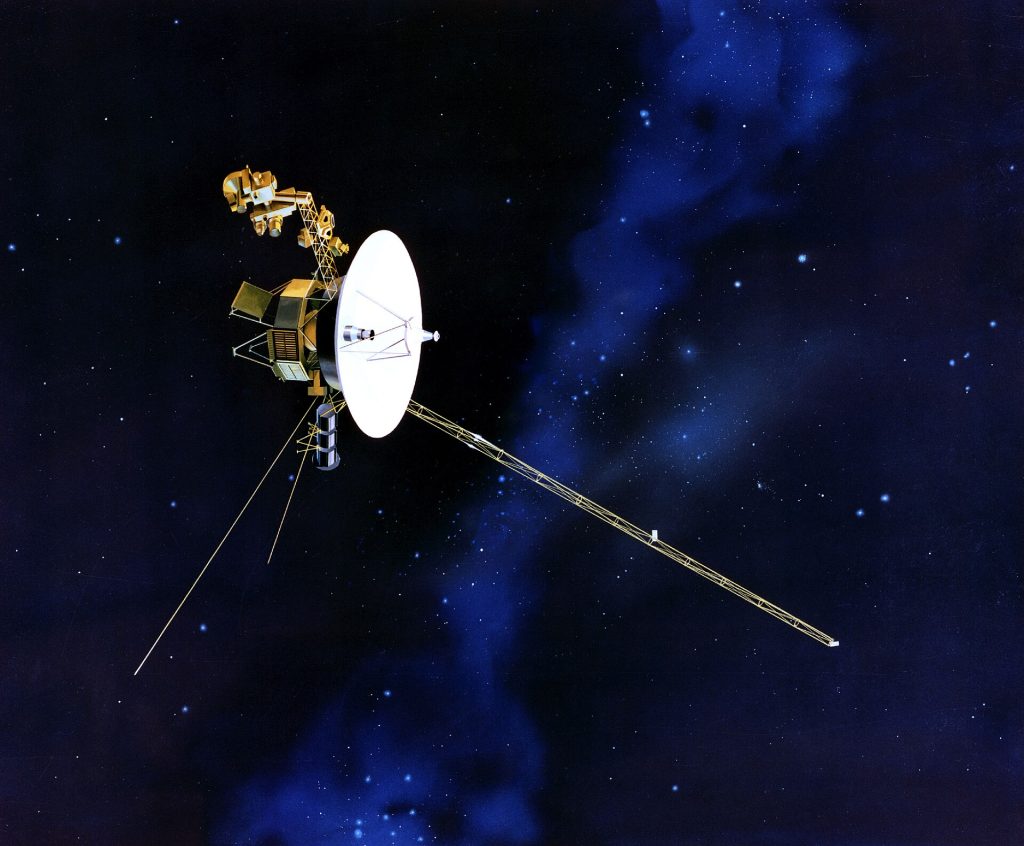
On Wednesday, November 18, Voyager 1 will be one light-day from Earth. The spacecraft that has traveled farther than any other human-made object will be 16.09 billion miles (25.89 billion kilometers) away — the distance light itself travels in a full day. A radio signal sent from Earth will take 24 hours to reach it, and the reply will take another 24 hours to come home.
It almost did not make it there. In October, NASA’s Jet Propulsion Laboratory — which manages the Voyager mission from right here in the San Gabriel Valley — announced that the 49-year-old spacecraft had twice gone silent, and that a power-saving maneuver completed in September is the reason its instruments are still running at all.
The “Big Bang” that bought Voyager time
Voyager 1 runs on radioisotope thermoelectric generators, which convert heat from decaying plutonium into electricity. The plutonium supply depletes a little every year, and both Voyagers lose about 4 watts of power annually. Nearly a half-century after launch, the margins had grown thin enough that the mission team had to shut things off to keep the science going.
In early September, engineers completed a months-long effort the team nicknamed the “Big Bang”: they turned off three devices aboard Voyager 1 and substituted three lower-power alternatives, all at the same time. The six devices help keep the spacecraft warm enough to operate in the frigid expanse of space, and only by swapping all three at once could the team both cut power use and keep heat distributed properly. The same swap had been performed on Voyager 2 about six weeks earlier.
Without the Big Bang, JPL says the mission would have needed to turn off another science instrument on Voyager 1 as early as summer 2027. The spacecraft launched in 1977 with 10 science instruments; several were switched off after the planetary encounters, and two more have been turned off in recent years as power dwindled. What remains is still doing science no other spacecraft can do: the Voyagers are traveling through interstellar space, beyond the bubble of particles and magnetic fields the Sun creates, and they are the only spacecraft ever to study that region directly.
Two days of silence — then the spacecraft fixed itself
JPL got a reminder in October of how fragile the mission is. NASA’s Deep Space Network — the large antennas at three facilities around the globe — was unable to detect a radio signal from Voyager 1 during two scheduled communications attempts on October 18 and 19, 24 hours apart. The signal reappeared on October 20, before the team had sent any commands to troubleshoot. Communication has continued since then.
Engineers are still investigating what caused the interruption. So far they have determined that one group of thrusters went offline and their backups turned on — an automatic response, called fault protection, in which the spacecraft’s computers put it into a safe, stable configuration and pause normal operations while engineers diagnose the problem.
“This is the first time we’ve seen the spacecraft do something like this, but we are also at a point in the mission where we have to expect the unexpected,” said Kareem Badaruddin, Voyager mission manager at NASA’s Jet Propulsion Laboratory in Southern California. “We’re relieved to be back in contact with Voyager 1 and are eager to understand what happened.”
What one light-day means
The spacecraft will not detect any change in its environment when it passes one light-day, and nothing will change aboard it. The milestone’s significance, JPL says, is in its demonstration of the vastness of the universe and the endurance of humanity’s most distant explorer.
“If you want to say ‘hello’ to Voyager, you send your message and then you go home and you wait two days before you finally get a response,” said Suzanne Dodd, Voyager project manager at JPL.
Voyager 1 is traveling at 38,000 mph (61,155 kph) in the direction of the constellation Ophiuchus. NASA is marking the milestone with a “Shine Bright for Voyager’s Light-Day” activation on Monday, November 17; details are at nasa.gov/voyager. And for locals who want the story in person, Caltech’s Watson Lecture series brings a Voyager talk to Beckman Auditorium on January 27, 2027 — as AltaPasa reported this week, JPL’s Linda Spilker, a veteran of the Voyager and Cassini missions, is on the season’s schedule.
A spacecraft built to last four years is about to put a full day of light-speed travel between itself and home — and, thanks to a power swap performed 16 billion miles away, it is still talking.
Sources: NASA Jet Propulsion Laboratory, “NASA’s Voyager 1 Conserves Power, Resolves Brief Communications Pause,” October 29, 2026; JPL, “What’s Up: November 2026 Skywatching Tips from NASA,” November 2, 2026.
